Canada has one of the largest and most diverse outfitting industries in the world. From drive-to fishing camps in Ontario and Quebec to remote fly-in lodges in Manitoba, trophy hunting operations in Alberta and British Columbia, salmon camps in Atlantic Canada and wilderness expeditions in the North, the word "outfitter" can describe very different experiences.
What these businesses generally have in common is that they help visitors access Canada's wilderness and outdoor resources by providing some combination of accommodation, equipment, transportation, guiding and local expertise.
The Canadian Federation of Outfitter Associations represents provincial and territorial associations encompassing more than 2,000 outfitting businesses. According to the Federation, Canada's outfitting industry supports more than 35,000 jobs and generates an economic impact exceeding $5 billion annually.
For travellers, however, the challenge is rarely finding an outfitter. It is finding the right outfitter for the experience they actually want.
What exactly is an outfitter?
There is no single Canadian definition that perfectly applies from coast to coast because wildlife, tourism and outfitting are largely regulated provincially or territorially.
At its simplest, an outfitter is a business that helps people experience hunting, fishing or wilderness recreation by providing services that would otherwise be difficult for visitors to organize themselves.
Depending on the destination, that might include:
- cabins or lodge accommodation
- boats and motors
- fishing equipment
- professional hunting or fishing guides
- meals
- transportation by boat, floatplane or vehicle
- access to remote camps
- assistance obtaining licences and tags
- game retrieval or processing
- shore lunches and equipment rentals
- wilderness activities for non-hunters and non-anglers
Some outfitters operate substantial full-service lodges. Others run small family businesses with only a handful of cabins. At the most remote end of the spectrum, an outfitter may fly guests into an isolated lake where a cabin, boats and motors are waiting — and where there may be no road access, cellular coverage or other development for many kilometres.
This diversity is one reason comparing Canadian outfitters simply by nightly price can be misleading.
Drive-to lodge, fly-in lodge or remote outpost?
One of the first decisions when planning an outfitter trip is how remote you want to be.
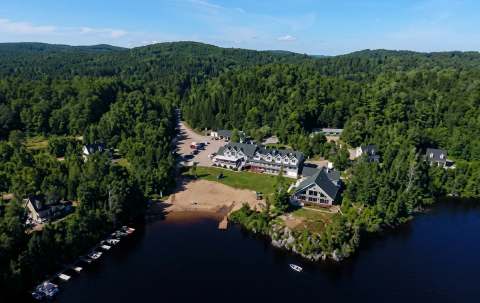
A drive-to outfitter is generally the easiest option. You arrive in your own vehicle, which makes it convenient to bring equipment, food and family members. Many excellent fishing destinations fall into this category, particularly in Ontario and Quebec.
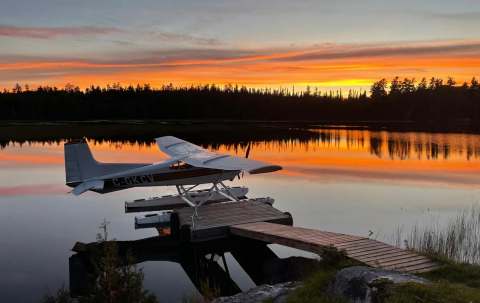
A fly-in lodge usually begins at a floatplane base. Guests and equipment are flown to a lodge located on a lake or river inaccessible by normal roads. These operations range from rustic fishing camps to surprisingly luxurious wilderness lodges with professional guides, dining rooms, electricity and comfortable private cabins.
An outpost camp generally offers even greater independence. Ontario defines commercial outpost camps as remote rental units away from the operator's main base that are accessible only by air, water or forest travel. Guests may be dropped off with boats, motors and supplies and then largely manage their own fishing experience until pickup.
Manitoba provides good examples of this range. The Manitoba Lodges and Outfitters Association represents everything from full-service northern fly-in lodges to family-oriented resorts and independent wilderness camps.
None is inherently better. A first-time family may appreciate a comfortable drive-to cabin, while a group of experienced anglers may consider being alone on a remote northern lake the entire point of the trip.
Fishing outfitters: start with the species
Canada's geography produces exceptionally varied freshwater and saltwater fishing. Before choosing a lodge, determine what you most want to catch.
Across Ontario, Manitoba, Saskatchewan and parts of Quebec, some of the most sought-after species include:
- walleye
- northern pike
- lake trout
- brook trout
- smallmouth bass
- muskellunge
Northern Canada adds exceptional opportunities for trophy lake trout, Arctic grayling and Arctic char. The Northwest Territories, for example, are internationally recognized for extremely large lake trout and northern pike.
British Columbia is particularly well known for Pacific salmon and steelhead as well as freshwater fisheries, while Atlantic Canada offers salmon and other distinctive coastal and river experiences.
A useful outfitter listing should tell you much more than simply "great fishing." Look for specific information about the species, lakes or rivers being fished, whether boats and motors are supplied, whether guides are available, and what is included in the advertised price.
Ask whether fishing is primarily guided or self-guided. Also determine whether the outfitter has access to one lake or several. Being able to move among different bodies of water can become particularly valuable when weather or fishing conditions change.
Hunting outfitters operate differently across Canada
For hunting, choosing an outfitter requires even more attention because regulations vary considerably between provinces, territories, species and residency categories. Western Canada's outfitting tradition is strongly associated with professional guided hunting.
In Alberta, outfitters are licensed professionals authorized to provide guiding services, and the Alberta Professional Outfitters Society currently represents approximately 500 professional outfitters and nearly 1,600 hunting guides. Alberta's outfitting history extends back to guided wilderness hunts in the late 1800s.
British Columbia operates a system of licensed guide outfitters and defined guiding territories. Provincial documentation describes guide outfitters as professionals authorized to guide hunters within clearly defined areas.
Other provinces and territories have their own systems. Requirements for Canadian non-residents and international hunters can differ substantially, and in some jurisdictions or circumstances the use of a licensed outfitter or guide is mandatory. Nunavut, for example, requires visiting hunters to use licensed outfitters.
For that reason, MyOutfitters.ca should be used as a discovery and comparison tool, while current hunting regulations should always be confirmed with the appropriate provincial or territorial government before travelling.
Canada's outfitting regions are remarkably different
Part of the appeal of the Canadian outfitting industry is that the experience changes dramatically as you travel across the country.
Ontario has an enormous resource-based tourism industry, particularly across Northern and Northwestern Ontario. Fishing lodges, remote outposts and fly-in camps are a defining part of tourism in many northern communities. Ontario officially defines resource-based tourism around the enjoyment of natural environments and resources on Crown lands and waters.
Manitoba is particularly associated with northern fishing lodges and remote wilderness experiences. Walleye and northern pike are major attractions, with many operations offering combinations of main-lodge accommodation and isolated outpost camps.
Saskatchewan offers extensive northern fishing opportunities as well as professional hunting operations. The Saskatchewan Commission of Professional Outfitters represents the province's professional outfitting industry.
Alberta is especially important for guided big-game and bird hunting, with opportunities that can include deer, elk, moose, black bear, waterfowl and other species depending on regulations and allocations.
British Columbia combines Pacific fisheries with one of Canada's best-known guide-outfitting traditions for wilderness hunting. Mountains, coastal environments and large remote territories create a very different experience from central Canada's lake-country lodges.
Quebec has one of Canada's most developed networks of businesses explicitly known as pourvoiries. Many combine fishing, hunting, cottages and family vacation experiences rather than focusing exclusively on professionally guided hunting.
Quebec also has a system rarely encountered elsewhere in Canada: ZECs, or Zones d'exploitation contrôlée. These are nonprofit-managed public wildlife territories created largely following Quebec's dismantling of many private hunting and fishing clubs beginning in the late 1970s. A ZEC is not an outfitter: visitors generally purchase access to a managed territory and organize more of their own experience, whereas a pourvoirie typically sells accommodation and services as part of the stay.
Newfoundland and Labrador has a strong tradition of hunting and fishing outfitters, with remote operations offering experiences ranging from Atlantic salmon fishing to moose, caribou and black bear hunting where regulations permit.
The Yukon, Northwest Territories and Nunavut represent the extreme end of Canadian wilderness travel. Distances are greater, access can depend heavily on aircraft, and trips often require considerably more planning — but the resulting isolation can be extraordinary.
What should you compare before booking?
The best outfitter is not necessarily the most expensive, the most remote or the one with the largest fish in its photo gallery. Start by comparing the practical details of the experience.
For a fishing trip, consider the target species, number and size of accessible lakes, boats and motors, guiding, fishing pressure and travel required to reach the lodge.
For hunting, compare the species, hunting area, guide ratio, territory arrangement, package duration, transportation, licensing requirements and exactly what happens after an animal is harvested.
For accommodation, check:
- number of bedrooms and actual beds
- private versus shared bathroom
- hot water, heating and electricity
- kitchen facilities and meal plans
- Wi-Fi or cellular service
- pet policies and accessibility
- distance from the nearest town or airport
Most importantly, determine what the quoted price includes.
A $2,000 fishing package that includes flights, accommodation, boat, motor, fuel, meals and guiding may be better value than a seemingly less expensive package where most of those items are additional.
American Plan, housekeeping and other terms worth knowing
Canadian fishing lodges often use terminology that may be unfamiliar to first-time guests.
American Plan: the lodge supplies accommodation and meals, and often a higher level of service.
Housekeeping plan: guests receive accommodation and basic facilities but prepare their own food.
Guided package: professional guiding for some or all fishing or hunting days.
Self-guided package: the infrastructure is provided — cabins, boats and motors — while guests fish independently.
Outpost package: accommodation at a remote satellite camp away from the main lodge.
Definitions can vary between operators, so always look at the actual inclusions rather than relying exclusively on the package name.
The outfitter can matter as much as the destination
Experienced anglers and hunters often return to the same outfitter year after year. There is a reason.
Local knowledge can be extraordinarily valuable in Canadian wilderness environments. A good outfitter knows which lake is productive under certain wind conditions, where fish tend to move at different times of year, which roads are passable, how water levels have changed, and how wildlife patterns vary across the territory.
Professional associations can also be useful resources when researching an operator. The Canadian Federation of Outfitter Associations connects travellers to provincial and territorial outfitter organizations. Provincial organizations such as the Alberta Professional Outfitters Society and the Manitoba Lodges and Outfitters Association provide additional information and member directories.
Reviews can help as well, but read beyond the star rating. Comments about boats, guides, cabin cleanliness, communication, meals, accessibility and whether the actual experience matched what was advertised are often more useful than the numerical score itself.
A uniquely Canadian way to experience the wilderness
What distinguishes an outfitter trip from an ordinary hotel stay is ultimately not the cabin. It is access.
Outfitters provide access to lakes, rivers, forests and wildlife experiences that many travellers would otherwise have difficulty reaching or understanding. Some have operated in the same area for generations, accumulating detailed knowledge of the surrounding landscape.
A trip might mean driving two hours from a major city to a comfortable lakefront cottage. Or it might involve a floatplane flying hundreds of kilometres north before landing beside an isolated cabin where your group will not see another person for a week. Both are authentically Canadian outfitter experiences.
MyOutfitters.ca is designed to make these choices easier by bringing Canada's outfitters together in one place and allowing travellers to compare the factors that actually matter: location, species, accommodations, packages, services, territory, accessibility and the type of experience being offered.
Whether you are planning your first family fishing weekend, searching for a trophy hunting destination, organizing an annual trip with friends or dreaming about a remote fly-in adventure, the best place to begin is by deciding what kind of experience you want — and then finding the Canadian outfitter that fits it.