Hunting
Coyote Hunting in Quebec: Forest or Farmland?
Explore the key differences between coyote hunting in farmland and boreal forests to help you plan the perfect predator hunting trip with a professional outfitter.
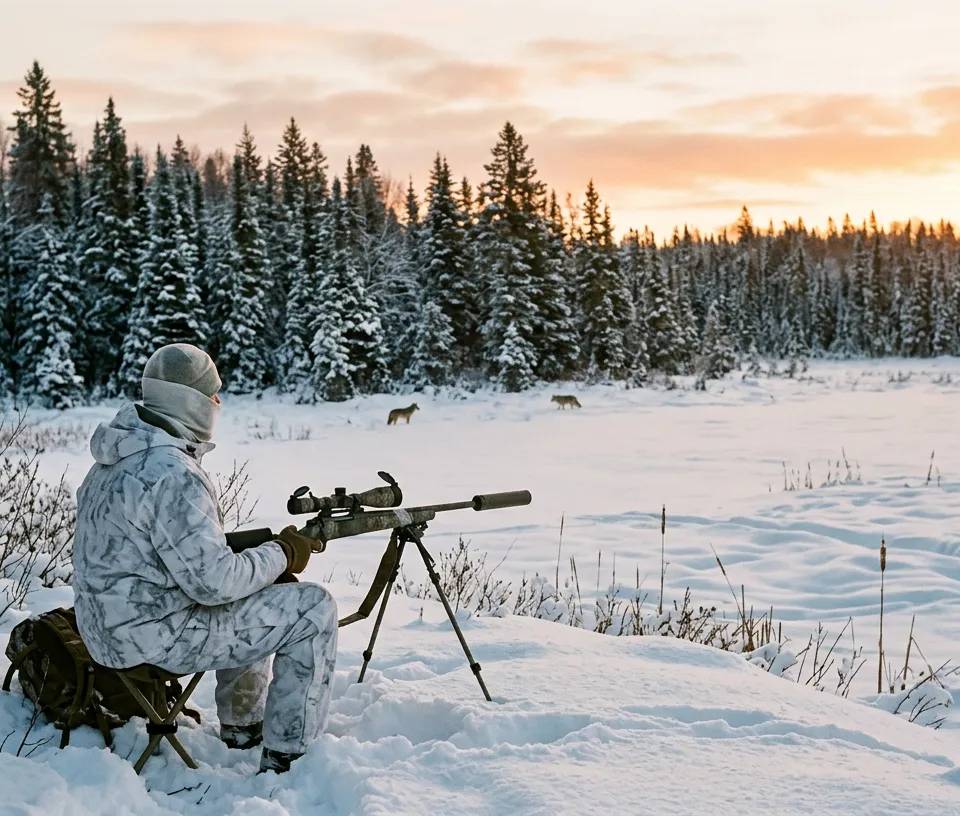
Coyote hunting in Quebec offers a unique winter challenge that tests both your gear and your patience. Depending on whether you choose the vast agricultural plains or the dense boreal forest, your tactical approach will need to adapt to ensure a successful harvest.
Farmland Hunting: Wide Open Spaces
In regions like Chaudière-Appalaches or the Eastern Townships, the landscape is dominated by large fields and woodlots. This environment favors long-range shooters and those who enjoy spotting predators from a distance.
- Long-range precision. You will often face shots at 200 yards or more. A high-velocity rifle with a quality optic is essential for these open stretches.
- Wind management. In the open, the wind is your greatest enemy. Coyotes will almost always circle downwind of your caller, using fence lines or ditches for cover.
- Decoy visibility. Using motion decoys is highly effective in fields, as the coyote can spot the movement from hundreds of yards away, drawing its focus away from your blind.
Forest Hunting: The Close-Quarters Game
Heading into the Laurentians or Mauricie means entering the dense woods where the coyote, and often the wolf, reigns supreme. Here, the hunt is intimate and fast-paced.
- Snap shooting. Sightlines are restricted. You might only have a few seconds to react when a coyote emerges from thick cover. A shotgun with heavy loads is a popular choice for these tight encounters.
- Sound travel. In the timber, sound is muffled. Callers need to be placed strategically near frozen lake edges or clear-cuts where the sound can reach further into the bush.
- Winter tracking. The deep forest snow reveals the coyote’s daily routines. Following tracks back to bedding areas or hunting grounds for small game is a key part of the forest scout's strategy.
Choosing Your Experience
The agricultural hunt is often more comfortable, with easier access and sometimes heated blinds. It is ideal for those who prefer stationary calling sessions. In contrast, forest hunting is more rugged, often involving snowshoes and moving between several calling stands throughout the day to find active animals.
Booking Your Coyote Expedition
Professional outfitters provide the advantage of pre-scouted territories and expert calling techniques. When booking, ask about their specific terrain—whether they manage vast private farm leases or extensive forest crown lands. Most coyote hunting packages run from mid-winter through early spring when pelts are at their prime. Contact your chosen outfitter directly through our directory to discuss gear requirements and local movement patterns before your trip.
Frequently asked questions
When is the best time for coyote hunting in Quebec?
The prime time is between January and March. This is when the fur is at its peak quality and coyotes are most active due to the mating season and food scarcity.
Should I use a rifle or a shotgun?
In open farmland, a small-caliber rifle (.22-250 or .223) is best for long-range precision. In thick forest, a 12-gauge shotgun with buckshot is more effective for close-range shots.
Is camouflage mandatory?
Coyotes have excellent vision. Full camouflage suited to the environment (white for snow, brush patterns for woods) is essential to avoid detection before taking your shot.
Do outfitters offer guiding services?
Yes, many outfitters offer guided packages that include transportation on the territory, calling the game, and sometimes skinning the harvest.
Can you hunt coyotes at night in Quebec?
Regulations allow night hunting in specific zones and during certain periods, often using lights. It is crucial to verify the current rules with your outfitter.