Hunting
Complete Guide to Grouse Hunting in Quebec
Discover the secrets of grouse hunting in Quebec: key habitats, woodland scouting strategies, recommended gear, and tips for your outfitter trips.
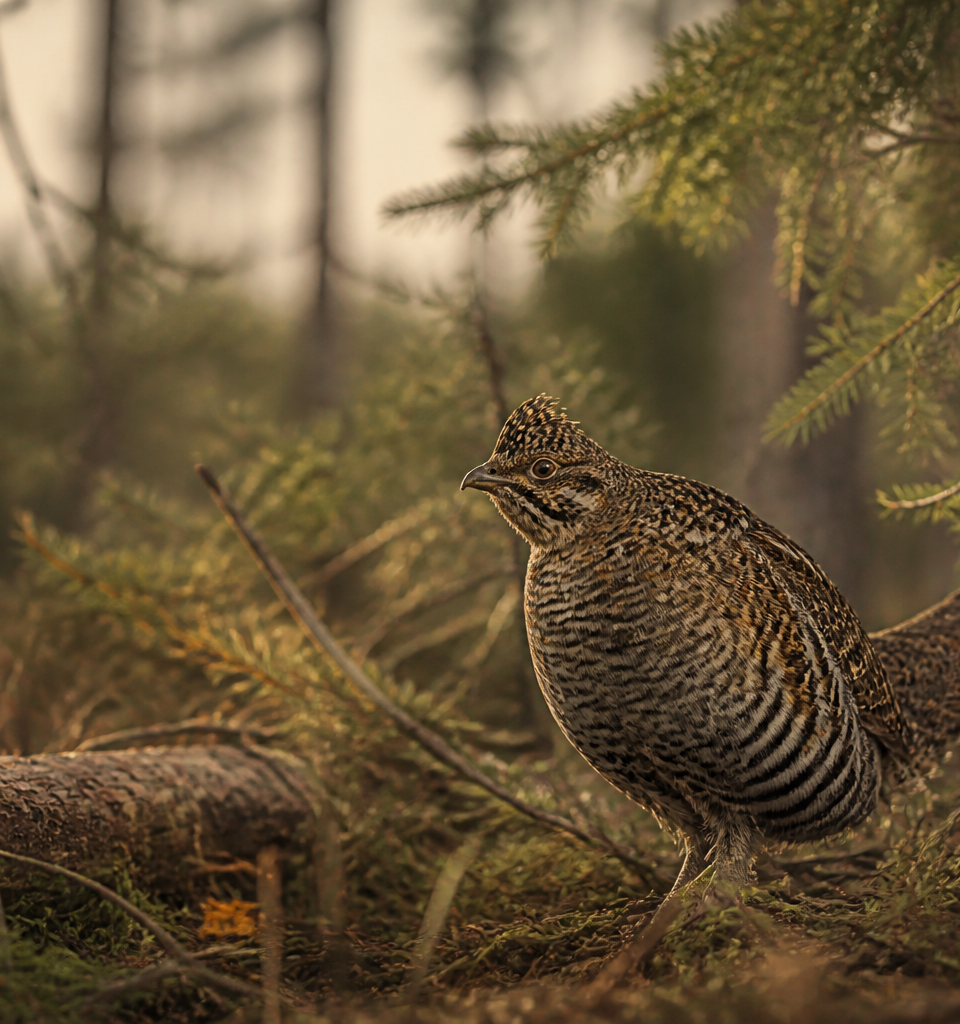
Species overview and identification
In Quebec, the colloquial term "partridge" (perdrix) primarily refers to two distinct native birds: the ruffed grouse and the spruce grouse. Although they belong to the same family of woodland gallinaceous birds, they have distinct morphological traits and behaviours that hunters should know how to identify in the field.
The ruffed grouse features plumage in shades of brown, grey, and rufous that blends seamlessly into fallen leaves and forest underbrush. It is identified by its small erectile crest on top of its head and its broad tail barred with a prominent black subterminal band that is clearly visible in flight. The spruce grouse, often called the "fool hen" or "spruce partridge", has darker plumage. The male displays a black throat bordered by white, a tail tipped with a buff band, and a distinctive red comb above the eyes, while the female has a more discreet, scalloped brown pattern.
Distinguishing between these birds in the bush is essential for hunters. The ruffed grouse is renowned for its alertness and explosive flush that often startles walkers, whereas the spruce grouse is generally more curious, less wary, and relies mainly on camouflage to avoid danger.
Habitat and geographic distribution
Ruffed grouse and spruce grouse are widespread throughout Quebec, from southern mixed-wood forests to the edges of the boreal taiga. Regions such as Abitibi-Témiscamingue, Mauricie, the Laurentians, Saguenay–Lac-Saint-Jean, Côte-Nord, and the Gaspé Peninsula offer vast territories suited to small game hunting.
Each species has its own cover preferences:
- Ruffed grouse prefer young mixed forest stands dominated by trembling aspen, birch, alder, and young conifers.
- Spruce grouse favour dense conifer woods, black spruce stands, jack pine forests, and the margins of mossy peatlands and bogs.
Transition zones where young regeneration, moist alder swales, and mature timber meet serve as prime travel corridors. Five- to fifteen-year-old cutovers provide abundant forage and dense protection against avian predators.
Behaviour and seasonal patterns
Bird behaviour changes considerably across the autumn season and under different weather conditions. Early in the season, in September, family broods are just beginning to disperse. Young birds actively seek wild berries, tender greens, and insects to build energy reserves before winter.
As leaves drop in October and November, their diet shifts dramatically. Ruffed grouse turn increasingly to aspen catkins and birch buds, while spruce grouse feed heavily on conifer needles. The loss of foliage increases visibility, often making birds edgier and more prone to flush at the slightest approach.
On a daily basis, activity peaks early in the morning and late in the afternoon. During these windows, birds step out of dense cover to feed and gather fine grit and gravel along trails, which is essential for their muscular gizzard to grind down tough plant fibres.
Best seasons and conditions
The fall season offers two distinct hunting atmospheres. Early autumn, with warmer temperatures and full foliage, requires sharp visual and auditory focus since birds remain concealed in thick cover. Late autumn, following the first hard frosts and leaf drop, greatly opens shooting lanes and makes it easier to spot birds budding in treetops at dusk.
Ideal weather conditions include:
- A crisp, calm morning without strong winds, encouraging birds to feed along trail edges.
- The morning after a heavy rain, when the sun warms forest edges and birds come out to dry their feathers.
- An overcast day with light drizzle, which keeps birds moving on the ground throughout the day.
High-wind days are the most challenging, as birds stay hunkered on the ground or buried deep in conifer branches for shelter and become exceptionally skittish.
Where and how to find it
To locate birds consistently, hunters must learn to read the forest landscape. Secondary logging roads, old skid trails, and snowmobile paths make prime corridors. These trails offer gravel for digestion, pioneer plants like clover, and quick escape cover when danger threatens.
Focus your scouting on edge habitats. A trail shoulder bordered by a wet alder swale on one side and young aspen regrowth on the other is a prime transition zone to work thoroughly. Always inspect the base of small conifers, the foot of large blowdowns, and lower limbs where birds like to loaf during the warmer midday hours.
Scan the woods methodically. Do not look for an entire bird; instead, look for anomalies in the undergrowth: a motionless rounded shape, an upright tail, or the glint of a dark, shiny eye amidst tangled branches.
Recommended techniques and strategies
Still-hunting on foot remains the classic approach in Quebec. It involves walking very slowly along logging roads and trails at a deliberate pace broken by frequent pauses. Taking three steps, pausing for ten to fifteen seconds, and moving again creates psychological tension for a concealed bird; thinking it has been detected, it will often flush or make a giveaway movement.
Hunting with a bird dog—whether a flushing breed like a spaniel or a pointing breed like a pointer, setter, or Brittany—transforms the pursuit. Dogs work dense cover that is impenetrable for humans, pin bird scent, and set up thrilling wing-shooting opportunities in tight timber.
To maximize solo success, keep your firearm at the ready and maintain strict stealth, avoiding heavy footsteps and slamming vehicle doors near hunting zones.
Equipment and gear
Firearm and ammunition choices depend on your preferred hunting style and shooting approach:
- A 20-gauge or 12-gauge shotgun with an open choke (improved cylinder or modified) and shot sizes #6 or #7.5 for shooting birds on the wing or in brush.
- A .410 shotgun, lightweight and easy to handle, favoured for taking close-range shots with minimal meat damage.
- A .22 LR rimfire rifle, ideal for precise headshots on grounded or perched birds, keeping breast meat completely intact.
For clothing, choose breathable layers to adapt to shifting daytime temperatures. A sturdy pair of waterproof hunting boots with solid ankle support is essential for navigating bogs, wet alder runs, and uneven deadfall. A game vest with a ventilated rear game bag keeps your harvest clean and cool while walking all day.
Regulations, licences and ethical practices
Upland game bird hunting in Quebec is governed by clear regulations designed to ensure sustainable wildlife populations. Every hunter must hold a valid hunter certificate and the appropriate small game hunting licence for the current season.
Daily bag limits and possession limits vary by provincial hunting zone. Hunters must strictly adhere to these quotas and follow all harvest reporting guidelines where applicable. Wearing blaze orange visible from all angles is mandatory during big game firearm seasons, which often overlap with fall small game hunting.
To check the latest information on open seasons, hunting zones, and bag limits, visit the official Government of Quebec (hunting and fishing) section. Regulations change annually: always verify the official dates and specific rules for your zone before heading out into the field.
Conservation, population and ecosystem role
Ruffed and spruce grouse populations experience natural cyclical fluctuations that typically span an eight- to ten-year period. These demographic cycles depend on winter severity, spring nesting success, and the abundance of natural predators such as Canada lynx, northern goshawks, and red foxes.
Hunters play an active role in wildlife conservation by funding habitat management programs and practicing fair-chase harvesting. Taking birds in moderation and avoiding harvesting an entire covey in a single small pocket helps maintain healthy breeding stock for future seasons.
Table fare is the ultimate reward of this ethical approach. The tender, lean meat of ruffed grouse, seared in butter with wild herbs or slow-cooked in a stew, ranks among the finest wild game delicacies Quebec has to offer.
Planning a guided trip or outfitter stay
Booking a hunting adventure at an outfitter provides access to expansive, well-managed forest territories that often feature exclusive trail networks. Whether you are a novice hunter looking to learn the ropes from a seasoned guide or a veteran sportsman seeking the comfort of a remote wilderness cabin, an outfitter trip offers an exceptional outdoor experience.
On-site amenities tailored to hunters, detailed territory maps, and advice from local staff on productive cover help optimize your time in the woods. You enjoy complete immersion in Quebec's backcountry with the safety and comfort of professional hospitality.
To find the perfect destination and book your next woodland adventure, explore the available outfitter options and plan your stay on MyOutfitters today.
Frequently asked questions
What is the main difference between ruffed grouse and spruce grouse?
Ruffed grouse feature grey-brown plumage, a head crest, and a black-banded tail. They are very alert and flush explosively. Spruce grouse are darker, generally less wary, and the male has a bright red comb over the eye.
Which firearm gauge or calibre is best for grouse hunting?
A 20-gauge or 12-gauge shotgun using #6 or #7.5 shot is ideal for wing shooting or brush hunting. For precision headshots on perched birds without damaging meat, a .22 LR rifle is a very popular choice.
What time of day are grouse most active?
Activity peaks during the first two hours after sunrise and again in late afternoon before dusk. During these windows, birds move from thick cover out onto trail edges to feed on clover and buds and pick up grit.
Why do grouse eat gravel along forest roads?
Like all gallinaceous birds, grouse have no teeth. They swallow small pebbles and coarse sand into their muscular gizzard to mechanically grind down seeds, hard berries, buds, and conifer needles.
Is it mandatory to wear blaze orange when hunting small game?
Wearing a blaze orange vest or jacket is mandatory whenever a firearm big game season is open in the zone you are hunting. For safety reasons, wearing blaze orange is strongly recommended at all times in the woods.
What type of forest habitat offers the best chance of success?
Focus on 5- to 15-year-old young mixed forests dominated by trembling aspen, birch, and alder near water sources. Forest road margins and logging cut edges are especially productive.
What is the best walking technique for still-hunting grouse?
Walk very slowly and pause regularly for 10 to 15 seconds. This stop-and-go pace makes hidden birds nervous; thinking they have been detected, they often give away their position or flush.
Can you effectively hunt grouse with a bird dog?
Absolutely. Pointing breeds (like pointers and setters) and flushing breeds (like spaniels) excel at locating birds tucked in heavy brush, providing great pointing action and wing-shooting opportunities.
How should grouse meat be handled and prepared?
Field dress the bird promptly after harvest and keep it cool. Ruffed grouse meat is mild and white, ideal for pan-searing in butter or roasting, while spruce grouse has a richer, more resinous flavour well-suited to braising and stews.
What are the advantages of hunting grouse at a Quebec outfitter?
Outfitters offer access to vast exclusive territories with extensive, uncrowded trail networks. They provide comfortable lodging, territory maps, and guidance from experienced staff to maximize your hunting success.