Hunting
Spruce Grouse Hunting in Quebec: Tips and Tactics
Discover how to hunt Spruce grouse in Quebec: boreal habitats, bird behaviour, prime seasons, recommended calibres, and practical tips for hunting at an outfitter.
Key takeaways
- Hunting generally opens in September and runs through winter depending on Quebec provincial hunting zones.
- This forest bird primarily inhabits dense black spruce stands, jack pine forests, and the edges of boreal peatlands.
- Walking slowly and methodically along trails is the key to spotting a bird famous for its lack of natural wariness.
- A provincial small game hunting licence is required to harvest this species anywhere in Quebec.
- Focus on coniferous stand edges rich in wild berries before snow covers the forest floor.
Identifying the Spruce Grouse in the Woods
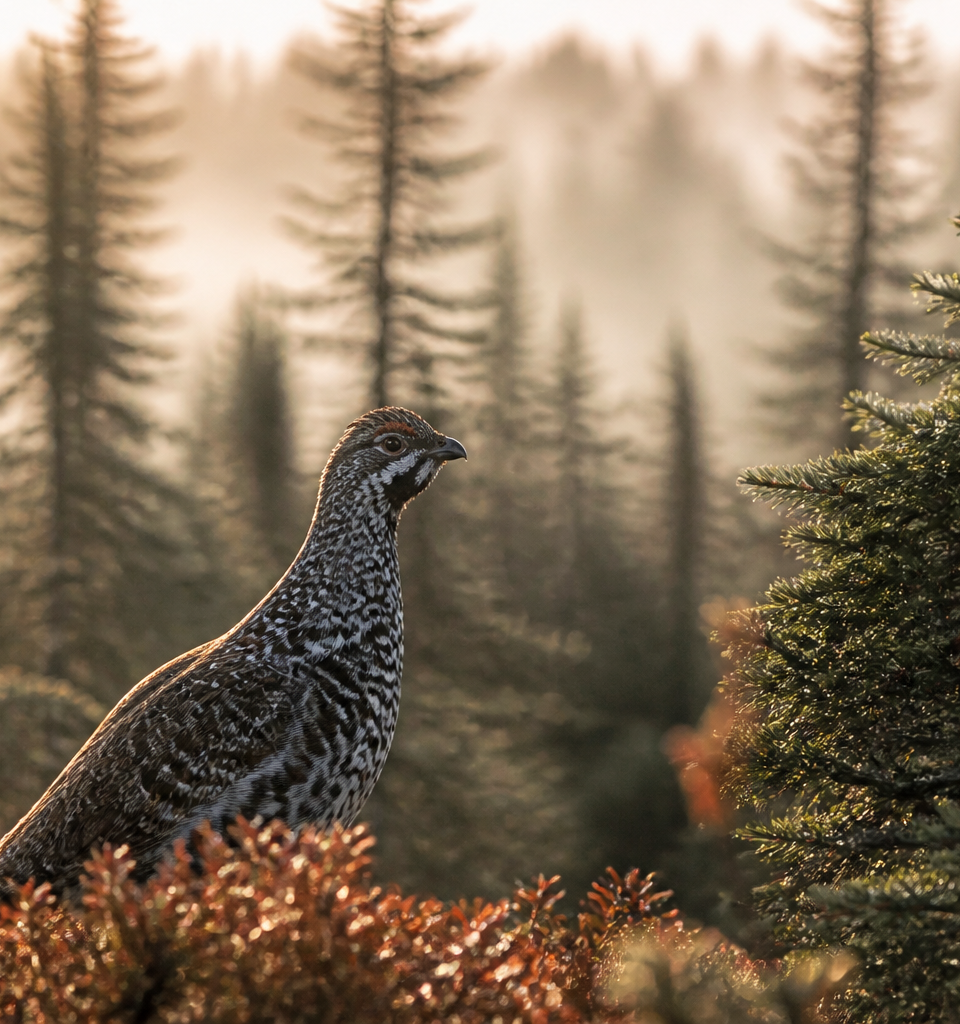
Spruce grouse (*Falcipennis canadensis*) is easily distinguished from other woodland gallinaceous birds by its dark plumage and, in males, a distinct bright red patch of bare skin above each eye.
This stocky upland game bird measures approximately forty centimetres in length. Males feature a solid black throat and breast bordered by white feathers that create a contrasting scaled pattern on the flanks and belly. The rounded black tail ends in a conspicuous chestnut-brown terminal band visible when fanned out. Females display far more cryptic plumage dominated by brown, beige, and tawny tones mottled with black, providing remarkable camouflage against the boreal forest floor.
In the field, hunters often compare this bird to the ruffed grouse, though they differ considerably in anatomy. Unlike ruffed grouse, which sport a dark neck ruff and a prominent crest on their head, spruce grouse have a smoother, rounder head with no raised crest. To learn more about woodland game birds across our forests, consult our Complete Guide to Grouse Hunting in Quebec.
In Quebec colloquial terms, this bird is often called *perdrix de savane* (swamp partridge) or *perdrix noire* (black partridge). Its reputation as a "fool hen" stems from its habit of freezing in place or calmly perching on a low spruce limb rather than flushing noisily when approached by humans.
Where Does the Spruce Grouse Live in Quebec?
In Quebec, the spruce grouse lives predominantly across the boreal biome, from Abitibi-Témiscamingue and Upper Mauricie through to Saguenay–Lac-Saint-Jean, the Côte-Nord, and Northern Quebec.
This species is closely tied to dense coniferous forest stands. It thrives in black spruce bogs, mature jack pine stands, and the fringes of open peatlands dotted with tamarack. The understorey ideally includes a thick carpet of mosses, lichens, and ericaceous shrubs such as wild blueberries, cranberries, and Labrador tea. To explore prime harvesting areas across the province, read our feature on Grouse Hunting in Quebec: Where to Find the Best Fall Forests?.
Unlike ruffed grouse, which favour mixed woodlands, aspen groves, and regenerating deciduous stands, spruce grouse generally steer clear of pure hardwood tracts in southern Quebec. Their numbers drop sharply once you reach the agricultural lowlands of the St. Lawrence Valley or the rolling hills of the Eastern Townships, where boreal conifers give way to maple woodlots.
Seasonal Behaviour of Wild Spruce Grouse
Spruce grouse adjust their behaviour and feeding habits dramatically to survive the seasonal extremes of Quebec's climate.
During late summer and early autumn, the bird spends most of its daylight hours foraging on the ground. It actively seeks out wild berries, mushrooms, herb seeds, and protein-rich invertebrates. During this window, family broods—consisting of the hen and her young of the year—often stay together, exploring sunlit edges where ground food remains abundant.
With the onset of hard frosts and November snowfall, its diet shifts almost entirely to conifer needles, primarily jack pine and black spruce. The bird becomes largely arboreal, spending long hours perched high in the conifer canopy feeding on and digesting this fibrous forage. Its digestive system adapts through a thickening of the gizzard and the lengthening of its intestinal caeca.
Its defensive strategy relies almost entirely on staying motionless. When facing potential danger, spruce grouse prefer to crouch tight to the ground or hop up a couple of branches to quietly watch the intruder—a trait that routinely surprises hunters used to the explosive flushes of ruffed grouse.
When to Hunt Spruce Grouse in Quebec?
Late September through late October offers the ideal window to hunt spruce grouse in Quebec, especially on calm, crisp autumn days.
During these prime weeks, falling shrub foliage substantially improves visibility in the boreal underbrush without yet driving the birds permanently into the high canopy. Bright, dry days following a hard morning frost are particularly productive: birds take advantage of the morning sun to warm up and move across the snow-free forest floor.
Early mornings shortly after sunrise and the last two hours before dusk are peak activity periods. This is when birds venture out from dense conifer cover to ingest grit along trails and feed on remaining wild berries along sunny edges.
Winter hunting remains possible in open zones from December onward, but it requires scanning the tree canopy and using snowshoes to navigate deep forest snowbanks.
How to Locate Spruce Grouse in the Field
Locating spruce grouse in the field requires glassing and carefully working sandy openings, secondary logging roads, and peatland edges.
Gravel forest roads are exceptional starting points. Like all gallinaceous birds, spruce grouse must consume small stones (grit) to grind tough needles and seeds inside their muscular gizzard. Sunny sandy cutbanks and trails bordered by young pine regularly draw birds seeking minerals and dusting areas to clean their feathers.
Reading sign significantly increases your odds. Inspect the ground along trails for distinct cylindrical droppings made of compacted needles, often capped with white at one end. Dark body feathers shed on a mossy stump or three-toed tracks pressed into damp sand confirm that a brood is actively using the area.
Never forget to check lower spruce branches two to three metres off the ground. When approached, spruce grouse often flush just a short distance and land on a horizontal limb, freezing tight against the tree trunk hoping to go unnoticed.
Effective Hunting Strategies for Spruce Grouse
A slow, deliberate walking pace remains the most reliable tactic to flush spruce grouse without walking right past them.
Use a stop-and-go cadence: take roughly fifteen slow steps, then pause completely for thirty seconds. This hesitation unnerves the bird. Assuming it has been spotted by a stationary predator close by, the grouse will often bob its head, emit a soft clucking alarm note, or shift slightly on the ground, instantly revealing its concealed position in the brush.
If hunting behind a well-trained pointing or flushing dog, keep in mind that spruce grouse behave differently from open-country upland birds. Dogs easily pick up their strong scent, but the birds rarely flush into long flights. A calm dog working close to the gun that can point birds perched at low heights is an invaluable partner.
When hunting in pairs, walk in a parallel line spaced roughly twenty metres apart through young jack pine plantations or bog fringes. This sweep formation covers ground thoroughly and intercepts birds attempting to quietly slip around hunters on the flanks.
What Gear and Calibre to Choose for Spruce Grouse?
A small-bore shotgun such as a 20-gauge, 28-gauge, or .410 bore is the premier choice for harvesting spruce grouse cleanly while preserving the table meat.
Because shots typically happen at close to intermediate ranges (between ten and twenty-five metres), a lightweight, nimble gun with an improved cylinder choke produces the ideal pattern. Field loads carrying #6 or #7.5 shot deliver plenty of knockdown energy without riddle-marking the breast meat. Small-calibre .22 rimfire rifles are also widely used in Quebec for precise headshots on perched birds.
Non-resident hunters travelling with their own firearms must comply with Canadian border regulations; review our complete guide on Bringing a Firearm into Canada for Hunting: The Complete Guide.
For footwear, choose waterproof hunting boots with aggressive lug soles built to handle saturated sphagnum bogs. Dress in quiet, technical layers to adjust to sharp temperature swings throughout the day, and carry all legally required safety items.
Spruce Grouse Hunting Regulations in Quebec
Spruce grouse harvesting in Quebec is subject to strict daily bag and possession limits established by each provincial hunting zone.
Every hunter must hold a valid small game hunting licence for the current season. During any period when firearms big game hunting seasons are open in your zone, Quebec law requires wearing a blaze orange vest that covers the chest and back and remains visible from all angles, along with blaze orange headwear.
Ethical hunters take safe, clean shots with clear backstops before squeezing the trigger. It is also good stewardship to avoid harvesting an entire localized covey from a small habitat pocket, preserving local breeding stock for future autumns.
For complete regulatory terms, zone boundary maps, and season dates, always consult the official Government of Quebec (hunting and fishing) resources. Regulations change every year: always verify exact dates, bag limits, and open zones with local wildlife authorities before heading afield.
Ecological Role and Conservation of the Spruce Grouse
The spruce grouse plays an integral role in Quebec's taiga ecosystem as a specialized herbivore and vital prey species.
This bird serves as an important food source for northern predators, including Canada lynx, northern goshawks, great horned owls, and American martens. By consuming large volumes of berries and seeds through summer and early fall, spruce grouse also assist in seed dispersal across the forest mosaic.
Healthy populations rely directly on large, contiguous tracts of structured boreal conifers. Sustainable forest management practices that maintain mature travel corridors and support natural spruce and pine regeneration remain essential for preserving this upland game bird in the face of climate and industrial pressures.
Booking a Spruce Grouse Hunting Trip in Quebec
Booking a stay at a Quebec outfitter is the most rewarding way to gain exclusive access to vast territories holding strong spruce grouse numbers.
Outfitters operating across the boreal zone manage extensive networks of uncrowded logging trails, regenerating cutovers, and walking paths ideal for still-hunting small game. Whether you choose a housekeeping package with a fully equipped lakeside cabin or an American plan guided stay, you will benefit from on-the-ground advice from outfitters who know their coniferous pockets inside and out. Explore specialized trips on Hunting Outfitters in Quebec to get started.
To plan your upcoming outfitter trip and secure prime terrain for the fall season, explore the outfitters listed on MyOutfitters today.
Frequently asked questions
Where can you find spruce grouse in Quebec?
Spruce grouse are found primarily throughout the boreal forest north of the St. Lawrence River, notably in Abitibi-Témiscamingue, Upper Mauricie, Saguenay–Lac-Saint-Jean, and the Côte-Nord. They favour dense black spruce stands, jack pine forests, and the edges of damp peatlands.
What calibre is recommended for spruce grouse?
Shotguns in 20-gauge, 28-gauge, and .410 bore are recommended for harvesting spruce grouse cleanly without damaging table meat. Shells with #6 or #7.5 shot provide an ideal pattern at close range. A .22 rimfire rifle is also popular in Quebec for taking precise headshots on stationary birds.
When does spruce grouse season open in Quebec?
The hunting season generally opens between mid- and late September depending on the provincial wildlife management zone. Seasons typically run through mid- or late winter. Always check the official provincial calendar for your specific hunting zone.
What licence is required to hunt spruce grouse in Quebec?
A standard provincial small game hunting licence issued by the Government of Quebec is mandatory. This licence covers ruffed grouse, spruce grouse, and snowshoe hare up to the specific daily bag and possession limits in each zone.
Why is the spruce grouse called 'perdrix de savane' in Quebec?
The traditional Quebec name comes from the bird's strong association with open peatlands, locally referred to as 'savanes' in northern regions. Early woodsmen used this name for the mossy, stunted spruce bogs where these birds permanently reside.
How do you cook spruce grouse after the hunt?
The dark, rich meat of spruce grouse is well suited to stews, slow braises, or seared breasts basted in butter with wild berries. Its fall diet of wild berries and fresh needles gives the meat a distinct, earthy woodland flavour prized by wild-game cooks.
What is the daily bag limit for spruce grouse in Quebec?
The daily bag limit for spruce grouse is combined with other grouse species and is typically set at five birds per day across most Quebec hunting zones. The total possession limit for a trip is generally a maximum of fifteen birds per licensed hunter.
Is wearing blaze orange mandatory when hunting spruce grouse?
Wearing a blaze orange vest and hat becomes legally mandatory whenever a big game firearm season is open in the zone you are hunting. Even outside big game seasons, wearing high-visibility orange is strongly recommended for safety in dense boreal bush.
Can you hunt spruce grouse with a pointing dog?
Yes, you can hunt spruce grouse with a pointing dog, though their behaviour differs from that of ruffed grouse. When scented, spruce grouse tend to hold tightly on the ground or fly up onto a low tree branch rather than flushing long distances.
What is the difference between a spruce grouse and a ruffed grouse?
Spruce grouse have much darker plumage, a solid black tail without a broad dark subterminal band, and males feature a bright red comb above the eye. Ruffed grouse feature a pointed crest on their head, a dark neck ruff, and lighter, mottled brown or grey plumage.