Hunting
Complete Guide to Wild Turkey Hunting in Quebec
Discover the best strategies, essential gear, and regulations for a successful wild turkey hunt in Quebec, from spring scouting to taking the shot.
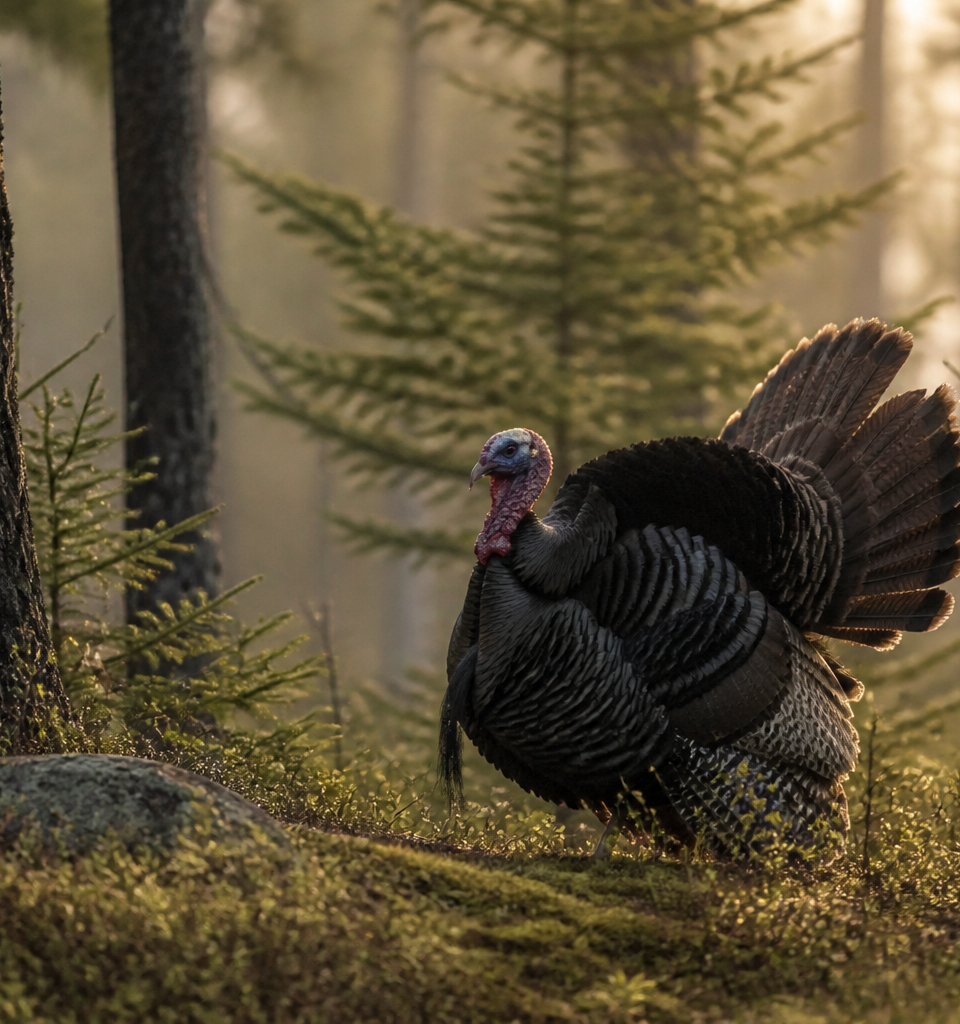
Species overview and identification
The wild turkey (*Meleagris gallopavo*) is one of the most spectacular and wary game birds in Quebec's wildlife landscape. This impressive bird displays pronounced sexual dimorphism that every hunter must master before stepping into the field. The adult male, commonly referred to as a "tom," boasts a heavy build that can exceed ten kilograms, dark plumage with shimmering bronze, copper, and green iridescence, and a featherless head with caruncles that shift from bright red to pale blue-white depending on excitement levels.
To properly identify a legal male, hunters must look closely for the beard—a tuft of modified, hair-like feathers protruding from the centre of the breast. In a young male of the year, known as a "jake," this beard is generally under ten centimetres, and the central tail feathers extend past the outer feathers when the fan is spread. The spurs located on the back of the legs are another reliable indicator of age: short and rounded on a jake, they become long, sharp, and curved on a mature tom.
The female, or hen, is noticeably smaller, typically weighing between four and six kilograms. Her plumage is a drabber, greyish-brown, providing perfect camouflage for ground nesting. Her head is covered with fine grey feathers, and she rarely displays a visible beard, though a very small percentage of hens can develop a thin one. Taking the time to glass carefully with binoculars before shouldering your firearm prevents any mistaken harvest during the hunt.
Habitat and geographic distribution
Wild turkeys have undergone a remarkable expansion across Quebec over the past few decades. Their preferred habitat is concentrated in the southern portion of the province, where fertile agricultural land borders mature deciduous forests. Regions like the Montérégie, Eastern Townships (Estrie), Outaouais, Centre-du-Québec, and Chaudière-Appalaches hold high population densities thanks to this ideal habitat mosaic.
The species seeks out diverse terrain that fulfills daily needs for food and shelter. Turkeys favour woodlots dominated by red oak, American beech, and sugar maple, which provide a forest floor rich in beechnuts, acorns, and samaras. Nearby agricultural fields planted with corn, soybeans, or small grains supply vital supplemental food sources needed to survive harsh Quebec winters and regain strength come spring.
Further north, in the foothills of the Laurentians, Lanaudière, and into southern Mauricie, wild turkeys are steadily colonizing sheltered valleys and river corridors. The northern boundary of their range remains heavily constrained by winter snowpack depth, which dictates their ability to travel and forage on the ground.
Behaviour and seasonal patterns
Understanding the biological rhythm of the wild turkey is the foundation of any successful hunt. In late winter, lengthening daylight prompts large winter flocks to break apart. Dominant toms begin strutting and sparring to establish their territorial hierarchy ahead of the breeding season. Morning gobbles echo across the woods to pull receptive hens toward display areas.
Wild turkeys are strictly diurnal and spend their nights roosted high in the upper limbs of large mature trees. At first light, birds vocalize from their perches before sailing down to the ground ("fly-down"). Toms strut with full fans, dragging their wingtips along the dirt while emitting low-frequency spitting and drumming sounds to court hens. By midday, flocks move along field edges to feed, dust bathe, and loaf in open areas that offer clear lines of sight.
In the fall, social dynamics shift dramatically. The breeding season is long over, and birds gather into affinity-based groups: hens stay with their young-of-the-year in tight family flocks, while mature gobblers form separate, highly cautious bachelor bands. Daily activity centers almost entirely on aggressive foraging to build fat reserves before the snow flies.
Best seasons and conditions
The spring hunt is undeniably the premier season for wild turkey in Quebec. This is when gobbler vocalizations hit their peak, and calling birds into range delivers an unmatched adrenaline rush. The opening weeks provide incredible action, though toms are frequently "henned up" (surrounded by real hens), making them difficult to pull away. As the season progresses and hens slip away to incubate nests in the morning, lonely toms become much more vulnerable to calling.
Weather conditions strongly dictate turkey behaviour. Calm, clear, and crisp mornings are ideal: vocalizations carry far, and birds quickly leave the roost to feed in the sun. In contrast, windy days hinder a turkey's acute hearing, making birds extremely nervous, tight-lipped, and reluctant to call inside thick timber.
On drizzly or foggy mornings, turkeys tend to vacate the woods early and head for open pastures and agricultural fields. Rain dripping from the canopy compromises their sight and hearing, prompting them to seek open ground where they can spot potential predators from afar. Setting up along field margins on overcast, damp days is often a winning tactic.
Where and how to find it
Harvest success is often decided well before opening day through diligent scouting. The first priority is locating active roosts. Walk forest edges at dusk or an hour before dawn, and use a shock call—such as a barred owl hoot or crow call—to trigger an instinctual "shock gobble" from a roosted tom.
On the ground, several key signs reveal turkey activity:
- Droppings: elongated, J-shaped droppings indicate a male, while small spiral or curled piles are left by hens.
- Scratchings: turkeys vigorously rake through forest leaf litter for mast and bugs, creating V-shaped clearings where the narrow point indicates the direction the bird approached from.
- Tracks: three-toed tracks in mud or soft sand reveal travel lines along field edges, fence lines, and logging trails.
- Dropped feathers and dusting bowls along dry field edges and sandy trails.
Once you find these clues, mapping the transition points between roost sites, feeding grounds, and water sources allows you to predict natural travel corridors and set up in high-percentage ambush spots.
Recommended techniques and strategies
The most classic and reliable spring approach is blind hunting or ground calling combined with realistic decoys and territorial vocalizations. Set up against a tree trunk wider than your shoulders to break up your silhouette, or hunt from a camouflaged ground blind. Placing a hen decoy alongside a submissive jake decoy fifteen to twenty metres away frequently triggers an aggressive territorial response from dominant toms.
Mastering your calls requires restraint. Simple clucks, soft yelps, and contented purrs are often far more convincing than endless, aggressive cutting sequences. Match the tom's excitement level and reply subtly to keep his curiosity alive without raising suspicion. If a gobbler answers consistently but hangs up out of range, reducing your calling or going completely silent for several minutes will often compel him to close the distance to find the "lost" hen.
Another approach, known as "run and gun," suits mobile hunters working large tracts of public or private timber. Walk ridges and logging trails cautiously, pausing periodically to throw out locator calls. The moment a tom strikes back, quickly slip to the base of the nearest suitable tree, get your gun up, and work him into range.
Equipment and gear
To defeat a wild turkey's razor-sharp eyesight—which detects movement and colour contrast instantly—head-to-toe camouflage is mandatory. This includes lightweight gloves, a full face mask, and silent clothing patterned to blend with the early spring Quebec woods, dominated by brown leaf litter, grey timber, and early green growth.
Your shotgun and load setup must deliver a dense, lethal pattern into a small target: the bird's head and neck. Twelve-gauge and 20-gauge shotguns chambered for 3-inch or 3.5-inch shells are the industry standard. An extra-full turkey choke tube is recommended to hold a tight pattern out to 20 to 40 metres. Modern Tungsten Super Shot (TSS) loads in #7 or #9 shot, or high-density lead in #4, #5, or #6, deliver devastating downrange energy.
Essential accessories include:
- A selection of calls: an easy-to-run wooden box call, a slate or glass pot friction call, and mouth diaphragm calls that keep your hands free on the gun.
- A thick, insulated seat cushion to stay perfectly still and dry during long setups.
- One or two high-realism decoys with lifelike postures and detailed paint finishes.
- A laser rangefinder to range landmarks around your setup before birds arrive.
Regulations, licences and ethical practices
Wild turkey hunting in Quebec is strictly managed to ensure sustainable populations. To hunt turkeys, Quebec residents must hold a valid Hunter's Certificate confirming successful completion of the PHTDS turkey hunting and biology course, along with the appropriate species-specific licence for the current season. The spring hunt primarily allows the harvest of bearded turkeys, with the opportunity to take a second bearded bird in designated wildlife management zones according to applicable rules.
Spring shooting hours are strictly limited, opening one half-hour before sunrise and ending at noon in most zones, allowing birds to feed, breed, and nest undisturbed through the afternoon. Mandatory registration of any harvested wild turkey must be completed within designated timeframes, either online or at an official big game registration station.
From an ethical standpoint, responsible hunters never shoot a bird off the roost, always wait for a clean, stationary head-and-neck shot on the ground, and respect private property by securing landowner permission beforehand. For complete regulations, open zones, and bag limits, consult the Government of Quebec (hunting and fishing). Regulations change annually: always verify the official rules before heading out.
Conservation, population and ecosystem role
The story of the wild turkey in Quebec is one of North America's greatest modern wildlife conservation success stories. Virtually absent from the province for much of the twentieth century due to habitat loss and historical overhunting in neighbouring regions, the turkey staged a massive comeback thanks to dedicated trap-and-transfer reintroduction initiatives spearheaded by provincial biologists and hunting federations, coupled with natural northward range expansion.
Today, Quebec's turkey populations are thriving and hold an important ecological niche. As opportunistic omnivores, turkeys disperse native plant seeds and naturally control populations of insects, grubs, and agricultural pests.
This current abundance should not overshadow the sensitivity of northern turkey flocks to severe winter conditions and changing forest landscapes. Hunters directly fund scientific research, flock monitoring, and habitat preservation through licence sales and mandatory harvest reporting, safeguarding biodiversity for future generations.
Planning a guided trip or outfitter stay
Booking a wild turkey hunt with an outfitter is one of the best ways to maximize your success while enjoying a safe, high-quality outdoor experience. Outfitters maintain exclusive access to extensive tracts of prime agricultural and wooded land where hunting pressure is carefully managed to keep birds responsive.
Hiring an experienced outfitter guide is an incredible asset, especially for newer turkey hunters or those with limited time for pre-season scouting. Professional guides know active roost locations, excel at calling wary old toms, and adjust setups on the fly to match bird behaviour and changing weather. Packages also frequently feature comfortable lodge or cabin accommodations along with game-dressing services.
Whether you are looking to bag your first spring tom or refine your calling skills alongside seasoned hunters, browse specialized destinations and book your next outdoor adventure on MyOutfitters, your go-to platform for planning unforgettable trips across Quebec.
Frequently asked questions
What is the difference between a jake and a mature tom?
A mature tom has a long beard exceeding twenty centimetres (8 inches), long, sharp spurs, and a smooth, even tail fan. A jake is a one-year-old male with a short beard under ten centimetres (4 inches), short, rounded spurs, and central tail feathers that stand taller than the rest of the fan.
What shotgun gauge is best suited for turkey hunting in Quebec?
A 12-gauge shotgun is the most versatile and popular choice, though 20-gauge shotguns have become increasingly effective with the advent of high-density Tungsten Super Shot (TSS) loads. Regardless of gauge, using an extra-full turkey choke is critical to concentrate pellets on the bird's head and neck.
What is the maximum effective shooting distance for wild turkey?
With standard lead loads, shots should be kept within 30 to 40 metres (approx. 35 to 45 yards). With premium TSS ammunition and a well-matched turkey choke, ethical shots can extend to 45 metres, provided you have verified your pattern on paper targets beforehand.
Why does spring turkey hunting close at noon in most zones?
The noon closing restriction protects the breeding cycle. Stopping the hunt at midday allows hens to feed and return to their nests to incubate eggs without human disturbance, while allowing toms to settle down peacefully for the rest of the day.
Do I need special training to hunt wild turkey in Quebec?
Yes. Quebec residents must successfully complete the PHTDS course (wild turkey hunting and biology). This certification is mandatory before you can purchase a wild turkey hunting licence online or from authorized distributors.
What is the easiest turkey call for a beginner to use?
A wooden box call is the easiest call to learn. It produces realistic yelps and clucks with a simple sliding motion of the paddle across the soundboard edge, requiring minimal practice compared to mouth diaphragms or friction pot calls.
What should you do if a gobbler answers your calls but hangs up out of range?
The most effective tactic is to drastically reduce your calling frequency or stop calling altogether for 10 to 15 minutes. Curiosity and impatience will frequently draw the tom in to search for the hen that suddenly went silent.
Can you hunt wild turkey in the fall in Quebec?
Yes, a fall turkey hunting season is open in specific wildlife management zones with high bird densities. Unlike the spring season, harvest rules in the fall may allow taking turkeys with or without a beard, depending on the specific zone regulations.
What is the best decoy setup for spring turkey hunting?
Place a feeding or receptive hen decoy alongside a jake or submissive tom decoy roughly 15 to 20 metres from your setup. Angle the jake decoy facing slightly toward your blind, as incoming dominant gobblers will typically circle to face their rival head-on.
Where do wild turkeys spend the night in Quebec forests?
Turkeys roost high in the canopy of large, mature trees—frequently white pines, large spruces, or mature hardwoods on leeward hillside slopes sheltered from the wind. Roosting off the ground protects them from nocturnal predators such as coyotes and foxes.