Hunting
Wolf Hunting in Quebec: Expert Guide and Winter Strategies
Discover the secrets of wolf hunting in Quebec: northern habitats, pack behaviour, winter blind techniques, specialized gear, and tips for planning your outfitter stay.
Species overview and identification
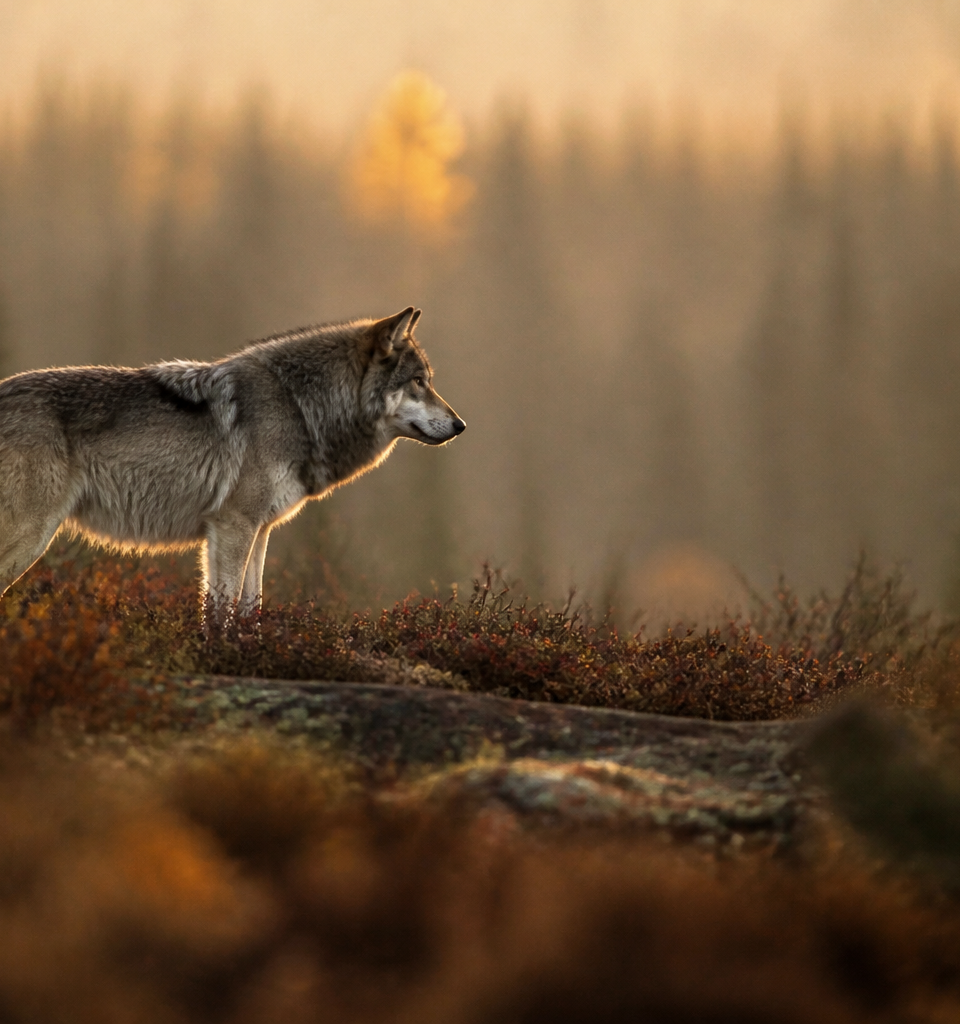
The grey wolf (*Canis lupus*) and the eastern wolf (*Canis lycaon*) embody the true essence of Quebec's wilderness. A majestic apex predator, the wolf is immediately distinguishable from its cousin the coyote by its imposing build, broad head with a blunter muzzle, short and rounded ears, and massive paws designed to support its weight on snow. An adult male in Quebec typically weighs between 30 and over 45 kilograms, carrying itself with a proud posture and a robust silhouette built for the harsh boreal environment.
A wolf's coat varies considerably from one individual to another across our forests, ranging from classic charcoal grey to deep black, creamy buff, and nearly pure white in northern reaches. Its gait is straight and deliberate: unlike domestic dogs or coyotes whose tracks meander and hesitate, a wolf places its hind paws directly into the tracks left by its front paws, leaving an impressively straight, uniform trail across the snowpack.
Positively identifying your target before pulling the trigger is critical. At a distance or in the dim light of dawn, an untrained eye can easily mistake a large eastern coyote for a wolf. Careful observation of head width, shoulder height, and gait will prevent any misidentification in the field.
Habitat and geographic distribution
Wolves inhabit a wide variety of forest ecosystems throughout Quebec, with particularly high concentrations in the continuous boreal forest, the taiga, and the mixed-wood ranges of the central and northern regions. Healthy, stable populations are found in Abitibi-Témiscamingue, the Upper Saint-Maurice (Haute-Mauricie), the northern Laurentians, Saguenay–Lac-Saint-Jean, the Côte-Nord, as well as across the vast expanses of Jamésie and Northern Quebec.
A single pack's home range is enormous, often spanning several hundred square kilometres depending on local prey density. These canids constantly travel natural and man-made corridors that facilitate fast, quiet travel, such as frozen waterways, large lake bays, open ridges, secondary logging roads, and remote hydro transmission right-of-ways.
Across these vast territories, wolf presence is inextricably tied to their primary prey species, particularly moose, white-tailed deer in the southern boreal transition zones, and snowshoe hare. Areas combining dense regenerating forest cover with large open spaces offer prime habitat for locating packs.
Behaviour and seasonal patterns
The wolf is a highly social animal whose pack structure revolves around a strictly ranked family unit led by a dominant breeding pair. This social organization grants the pack formidable hunting efficiency and remarkable collective intelligence. Vocal communication—most notably howling at dusk or prior to a hunt—serves to coordinate pack movements, rally separated members, and firmly mark territorial boundaries against rival packs.
In spring and early summer, pack life centres around dens and rendezvous sites where the breeding female raises the pups. Movements are relatively constrained during this period. By autumn, the juveniles join the adults on hunts to sharpen their skills, significantly expanding the pack's operational radius across the territory.
Winter dramatically shifts wolf behaviour. Bitter cold and heavy snowpack push wolves into an active, opportunistic nomadic pattern. Packs patrol traditional travel routes relentlessly, taking advantage of areas where ungulates struggle to move through deep powder. Late winter also marks the breeding season, characterized by heightened territorial aggression and sharp responsiveness to vocal challenges.
Best seasons and conditions
The winter season, running from December through March, is undeniably the prime time for wolf hunting in Quebec. The widespread snow cover transforms the landscape, creating stark visual contrast that silhouettes dark coats while offering clean, readable tracks on the ground.
Weather conditions play a decisive role in hunting success. The aftermath of a major snowstorm—when skies clear and winds drop—prompts packs to resume active hunting after hours of hunkering down. Crisp, calm, sub-zero days provide optimal acoustic conditions for long-range calling.
Light conditions are another critical factor. The first light of dawn and the final hour before dusk offer peak activity windows. On clear, cold nights, moonlight reflecting off the snowpack can occasionally reveal extended twilight movements across open expanses.
Where and how to find it
Finding wolves requires endless patience and a keen eye for reading Quebec's backcountry. The first step involves scouting for fresh sign along natural travel corridors: fresh tracks crossing a forestry road, scat containing hair and bone fragments, or scent markings along trail edges.
Large frozen lakes and open muskegs serve as strategic vantage points. Wolves frequently cross these openings to bypass thick brush without expending unnecessary energy in deep snow. Locating a recent natural kill or a legally maintained bait site is often the key to holding a pack in a specific area for several consecutive days.
To increase your odds, focus on valley junctions, frozen river mouths, and the edges of recent cutovers where wintering moose concentrate to browse. Regularly glassing these locations from elevated vantage points or monitoring them with cellular trail cameras will help you decipher the pack's travel patterns.
Recommended techniques and strategies
Wolf hunting in Quebec relies primarily on two proven approaches: bait-site hunting from a blind and territorial predator calling.
- Hunting over bait from a blind: This method involves setting up a fixed shooting position, ideally an enclosed, windproof blind positioned 100 to 200 metres from a legally established bait site. Absolute scent control is non-negotiable, as a wolf's sense of smell is remarkably keen. Complete stillness and silent discipline are mandatory during long hours of waiting in freezing temperatures.
- Wolf calling (vocal or electronic): This exciting technique involves imitating rival pack howls to trigger a territorial defense response, or using prey distress sounds (snowshoe hare, fawn distress) to lure a hungry predator into shooting range. Calls should be spaced out with extended periods of silence to carefully glass timber edges without giving away your position.
- Tracking on fresh snow: Reserved for seasoned trackers, this walk-in approach involves following fresh tracks into the wind in hopes of catching an animal bedded down. A wolf's legendary wariness makes this technique exceptionally difficult, but immensely rewarding.
Regardless of your chosen strategy, wind management is the absolute rule: a wolf that catches human scent hundreds of metres away will vanish instantly without ever stepping into the open.
Equipment and gear
Braving a Quebec winter while matching wits with wary wolves demands specialized gear engineered for extreme cold and precision mid- to long-range shooting.
- Rifle and ammunition: Choose flat-shooting calibres that deliver outstanding terminal accuracy, such as .243 Winchester, 6.5 Creedmoor, .270 Winchester, .308 Winchester, or .30-06 Springfield. Select high-precision bullets designed for rapid expansion.
- Precision optics: A high-transmission, high-magnification riflescope (e.g., 3-15x50 or 4-16x50) with an illuminated reticle is essential for dealing with low dawn and dusk light against bright snow. Premium binoculars (8x42 or 10x42) and an angle-compensating laser rangefinder complete your optics package.
- Cold-weather clothing and snow camo: A reliable layering system is vital, pairing merino wool base layers with high-loft down or synthetic mid-layers and a windproof, breathable outer shell in full snow camouflage. Pack heated gloves or fold-back mittens, a white balaclava, and extreme-cold winter boots rated for severe sub-zero temperatures.
- Shooting accessories and transport: A sturdy shooting tripod or rifle-mounted bipod, quiet traditional babiche or modern composite snowshoes, a thermal cover to shield your action and glass from frost, and an insulated seat pad for long sits.
Regulations, licences and ethical practices
Wolf hunting in Quebec is strictly regulated to ensure sustainable populations while allowing for responsible sport harvesting. Wolves are generally classified as furbearing animals or small game depending on applicable regulations, and hunting them requires a valid hunting licence and strict adherence to season dates specific to each provincial hunting zone.
Certain zones, particularly around national parks or in southern areas where eastern wolf populations are closely monitored, may have specific restrictions or complete harvest prohibitions. Mandatory registration of harvested wolves at an official station or online is required in several wildlife management units.
Ethical hunting requires absolute positive target identification, taking clean, lethal shots that minimize animal suffering, and fully utilizing the harvest, notably through proper pelt handling and working with a certified taxidermist or tanner. To review all current regulations, visit the official Government of Quebec (hunting and fishing) website.
Regulations change every year: always verify the official rules in effect before your departure.
Conservation, population and ecosystem role
The wolf sits at the top of Quebec's food chain and plays a vital role in balancing boreal ecosystems. As an apex predator, it regulates ungulate densities, contributes to natural selection by culling old, injured, or sick animals, and prevents the overbrowsing of shrubs and saplings that support countless other wildlife species.
Regular population surveys conducted by provincial biologists confirm that wolf populations remain healthy throughout the continuous boreal forest. Thanks to high ecological adaptability, strong reproductive rates, and vast tracts of protected habitat, wolves maintain viable populations while coexisting with regulated human activities.
Modern wildlife management does not aim to eradicate the predator, but rather to maintain a balanced relationship between wildlife conservation, healthy ungulate herds, and sustainable harvest opportunities. By practicing ethical and regulated hunting, sportsmen actively participate in the stewardship of Quebec's wilderness.
Planning a guided trip or outfitter stay
Pursuing wolves in the dead of a boreal winter is a true wilderness adventure that requires meticulous logistics. Booking with a Quebec outfitter is the safest and most effective way to experience this challenging hunt. Outfitters hold expansive exclusive rights or territorial access, maintain strategically placed, heated blinds, and operate snowmobile fleets suited for reaching remote wilderness areas.
A local guide's field knowledge makes all the difference against such a cunning quarry. Their familiarity with local pack corridors, consistent baiting weeks prior to your arrival, and expert calling skills substantially increase your odds of success. Furthermore, you will enjoy the warmth and comfort of a remote camp or main lodge, where a hot, hearty meal awaits after a long day in the biting cold.
Whether you are an experienced hunter in pursuit of a premier winter trophy or an outdoors enthusiast eager to experience the remote boreal backcountry, the MyOutfitters team is here to guide you toward the perfect destination. Plan your next guided outfitter trip on MyOutfitters today and prepare to experience the raw intensity of Quebec's vast wild spaces.
Frequently asked questions
How do you quickly tell a wolf from a coyote in the woods?
A wolf is roughly twice the size of a coyote, featuring a broad head, a blunt muzzle, and short, rounded ears. Its tail is carried straight or low, and its large paws leave tracks exceeding 10 cm in length. A coyote has a lighter build, pointed ears, a slender muzzle, and a much narrower stride.
What is the best rifle calibre for hunting wolves in Quebec?
Flat-shooting, versatile calibres like the .243 Winchester, 6.5 Creedmoor, .270 Winchester, and .308 Winchester are ideal. They provide pinpoint accuracy at longer ranges on a solid-bodied animal while preserving the quality of the winter pelt.
Why is wolf hunting primarily conducted in the winter?
Winter provides superior visibility because the white snow contrasts sharply with the wolf's darker coat. Snow cover also allows hunters to locate fresh tracks, interpret pack travel routes, and intercept animals near active food sources or travel lanes.
Are prey distress calls or territorial howls more effective?
Both strategies complement each other. Prey distress sounds (like snowshoe hare) lure hungry or curious wolves into close range. Territorial howls imitate an intruder and provoke an aggressive territorial response from the pack, which is especially effective during late winter breeding season.
What shooting distances should you expect when hunting from a blind?
Most shots from a baited blind range between 80 and 200 metres. However, in wide-open expanses like frozen lakes or large clearcuts, shots out to 300 metres may occur, requiring solid shooting rests and a firm grasp of ballistics.
How do you manage human scent in severe boreal cold?
Wash all hunting apparel in scent-free detergent and air-dry outside. Avoid wood smoke and cooking odours prior to your sit, apply scent-neutralizing field sprays, and always ensure your blind or stand is set up downwind of the target area.
Can you hunt wolves with a bow or crossbow in Quebec?
Yes, where allowed by regional weapon regulations. However, given a wolf's extreme wariness and reluctance to approach structures, archery hunting demands flawless camouflage, strict scent control, and an enclosed blind placed at close range.
What are the most reliable field signs indicating a wolf pack is nearby?
Look for straight, deep track lines along frozen waterways, scat packed with hair and bone chips, pungent yellow urine scent markings on snowbanks, and recently scavenged moose or deer carcasses.
How should you care for a wolf pelt in the field after the harvest?
Avoid dragging the carcass over rough, abrasive terrain to prevent damaging the guard hairs. Skin the animal cleanly as soon as possible without puncturing muscle tissue, scrape away excess fat, salt the hide heavily with non-iodized salt, or freeze it flat before taking it to a licensed taxidermist.
What is the main benefit of hunting wolves with an outfitter?
An outfitter preps the territory weeks in advance by establishing active bait sites and maintaining warm, strategically placed blinds. Their deep understanding of local pack movements and snowmobile logistics dramatically improves your chances of harvesting a wolf under demanding winter conditions.