Hunting
Everything About Caribou in Quebec: Hunting, Biology and Fieldcraft
Discover Quebec caribou, their tundra behaviour, spot-and-stalk tactics, population status, and how to plan a northern outfitter wilderness adventure.
Species overview and identification
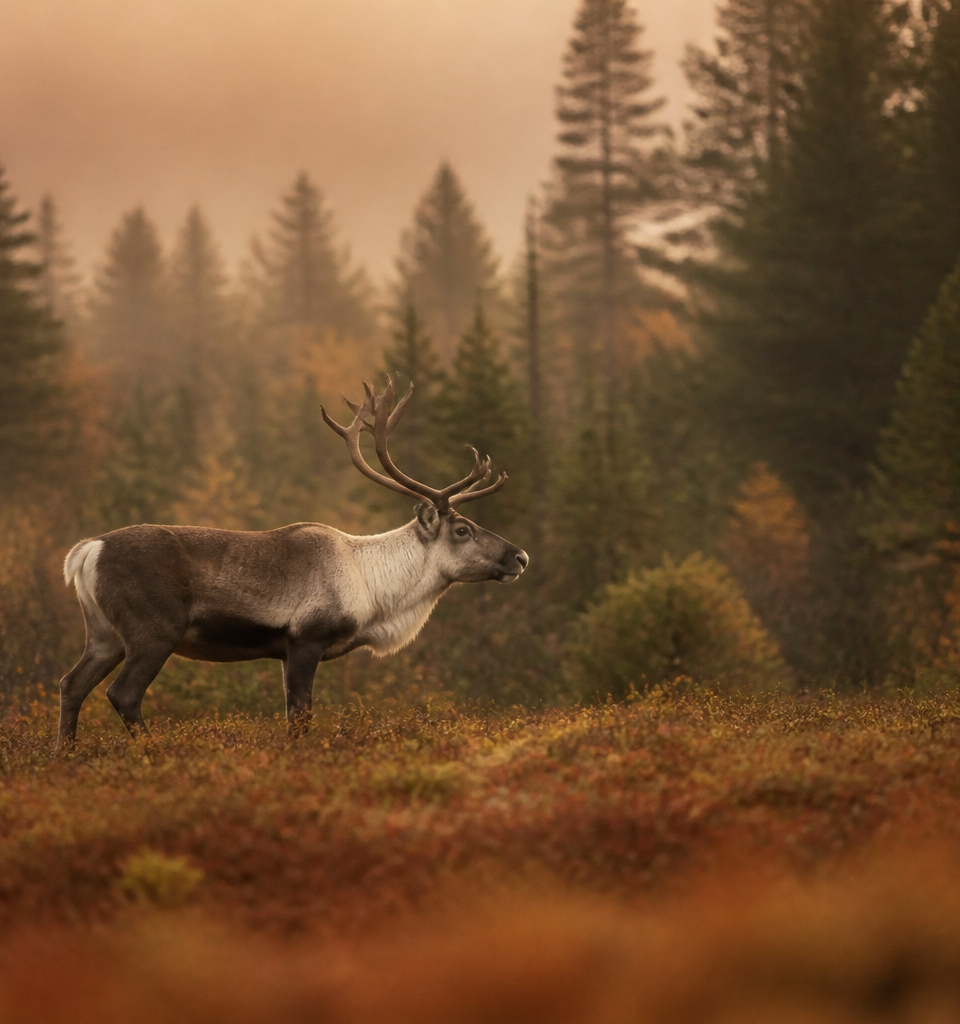
The caribou (*Rangifer tarandus*) epitomizes the wild majesty of Quebec's expansive boreal and Arctic wilderness. This iconic cervid differs from its cousins, such as moose and white-tailed deer, through several remarkable anatomical adaptations forged by the harsh northern climate. One of the species' most fascinating traits is that both males and females grow antlers. Mature bulls carry massive racks featuring a distinct brow tine or shovel extending forward and down over the bridge of the nose. Bulls drop their antlers in early winter, while cows retain theirs until spring calving to defend prime feeding craters in the snow.
A caribou's coat is a marvel of thermal insulation. Composed of dense woolly underfur and hollow guard hairs filled with air, it traps body heat and provides exceptional buoyancy when swimming across wide northern rivers. Coat coloration varies considerably by season and individual, shifting from a rich chocolate brown in late summer to a pale grey-buff in winter, often accented by a striking white neck mane on mature bulls. Their large, concave hooves with well-developed dewclaws function like natural snowshoes on soft snow and muskeg, while doubling as efficient scoops to crater through the snowpack in search of food.
In Quebec, two primary ecotypes are recognized: the migratory tundra caribou, renowned for its spectacular gatherings and long-distance movements, and the boreal woodland or mountain caribou, which lives in smaller, more secretive bands within continuous boreal forest and isolated mountainous terrain.
Habitat and geographic distribution
Caribou range across Quebec's most awe-inspiring and rugged landscapes, primarily across the Middle North, Far North, and the subarctic reaches of Nunavik and James Bay. These territories are defined by taiga, black spruce-lichen woodlands, and open tundra, where stunted trees gradually give way to a low-growing carpet of ericaceous shrubs, dwarf birch, and mosses.
Terricolous lichens, particularly *Cladonia* species (commonly known as reindeer lichen), form the cornerstone of the caribou's cold-weather diet. This slow-growing organism thrives on sandy soils, eskers, and well-drained plateaus across the Canadian Shield. In summer, herds take advantage of wet valley bottoms, bogs, and riparian corridors rich in protein-packed fresh grasses, willows, and sedges.
The geography of Quebec's herds has historically been shaped by vast migration corridors. Migratory caribou travel thousands of kilometres between open spruce stands at the southern end of their range and vast northern tundra plateaus. A complex watershed dotted with massive lakes, such as the Jamésie reservoirs and major rivers flowing toward Ungava Bay, heavily influences how herds navigate the land.
Behaviour and seasonal patterns
A caribou's life cycle is governed by the relentless rhythm of northern seasons and near-constant movement. In spring, migratory herds begin a dramatic northward trek. Pregnant cows lead the march toward traditional calving grounds on high tundra plateaus, where predator densities are lower and lingering snowdrifts provide welcome relief from heat.
During summer, animals face swarms of biting insects, including black flies and botflies. To escape this relentless harassment, caribou seek out residual snowbanks, wind-swept ridges, and open water where they submerge themselves frequently. This constant movement also prevents overgrazing of fragile lichen mats.
Autumn triggers the return migration southward and heralds the rut, which peaks between late September and mid-October. Dominant bulls develop thick layers of back fat, their necks swell, and they gather harems of cows, defending them through aggressive antler sparring. With the arrival of winter, herd energy shifts entirely to survival; animals slow their movements to conserve precious calories in extreme cold.
Best seasons and conditions
Autumn is the premier window to observe or hunt caribou in northern Quebec. From late August through early October, the tundra ignites in vibrant shades of crimson, ochre, and gold, providing breathtaking visual contrast. This is when caribou sport their prime early-winter coats and mature bulls have stripped their velvet, revealing polished ivory antlers stained with earthy reds.
Weather conditions dictate the success of any northern expedition. Crisp days with steady winds are ideal: the breeze keeps insect activity down, encourages animal movement, and allows hunters or observers to use air currents to mask their approach. Hard morning frosts make dry lichen crunch underfoot, demanding extra care when moving silently, but the crystal-clear atmosphere offers visibility across miles of open terrain.
The first autumn snowfalls transform the landscape dramatically. Fresh snow makes tracking and reading recent herd movements straightforward, but it also signals the need for heightened vigilance against sudden temperature plunges and early blizzards that can sweep across the taiga in hours.
Where and how to find it
Locating caribou across the boundless Quebec tundra requires a sharp eye for terrain features and local topography. Herds do not travel at random; they use natural travel corridors shaped over millennia. Sandy eskers, exposed bedrock ridges, and gravel riverbars serve as preferred highways where footing is firm and lines of sight are wide open.
Strategic use of elevated glassing points is essential. By setting up on a hilltop or rocky outcrop overlooking a drainage basin, you can scan entire horizons with quality optics. Caribou often move at a steady, ground-eating trot; a practiced eye will pick out this continuous gait against the backdrop of stationary boulders and stunted vegetation.
Lake narrows and river bottlenecks are prime intercept locations. Caribou readily swim water obstacles, but they consistently choose the shortest crossings with gentle approach banks. Pinpointing these natural funnels substantially increases your chances of crossing paths with travelling groups without disrupting their natural pace.
Recommended techniques and strategies
Hunting and approaching caribou across open terrain relies on two proven tactics: spot-and-stalk and strategic ambushes along natural travel routes.
- Spot-and-stalk always begins with deliberate glassing from an elevated vantage point. Once a herd or mature bull is spotted, carefully assess its travel trajectory and anticipate its future position.
- Stalking in open tundra demands absolute wind awareness, as caribou possess an exceptional sense of smell. Always circle wide around the group to maintain a steady headwind or crosswind.
- Make full use of micro-terrain: drainage swales, glacial erratic boulders, and low ground provide essential cover when vegetation barely reaches knee height.
- An interception strategy involves flanking the herd at a generous distance to set up ahead of its projected route, taking advantage of a natural saddle or pass.
Patience remains your greatest asset. Caribou are fast walkers, and trying to chase them down from behind is usually futile and exhausting across soft tundra soils. The secret lies in anticipating their route and letting the animals feed naturally toward your concealed position.
Equipment and gear
A northern Quebec expedition leaves zero room for gear compromises. Subarctic weather can turn from mild sunshine to a freezing blizzard within hours. A dedicated layering system built around merino wool base layers and breathable synthetic mid-layers is indispensable, capped by a rugged, windproof and waterproof breathable outer shell.
Key gear essentials include:
- Heavy-duty, fully waterproof mountain hunting boots with superior ankle support for navigating slick boulders and spongy muskeg.
- Premium optics, including 10x42 high-definition binoculars on a chest harness and a sturdy spotting scope on a solid tripod for long-range glassing and trophy evaluation.
- A rifle chambered in a flat-shooting, wind-resistant calibre suitable for open-country shots (such as .300 Winchester Magnum, 7mm Remington Magnum, or .30-06 Springfield), topped with a clear, weatherproof optic.
- A rugged pack with a reinforced internal or external frame capable of hauling heavy quarters over uneven backcountry terrain.
- A comprehensive wilderness first-aid kit, trekking poles for balance on difficult crossings, and a reliable two-way satellite communicator.
Regulations, licences and ethical practices
Caribou wildlife management in Quebec is governed by strict regulations established to protect population health and honour Indigenous treaty rights. Over recent decades, major herds, notably the George River and Leaf River herds, have experienced significant cyclical declines. Consequently, provincial wildlife authorities have implemented targeted conservation measures, including temporary closures of sport hunting for specific herds.
Every ethical hunter and outdoors enthusiast must verify the current legal framework before planning any harvest-related trip. Northern hunting ethics emphasize deep respect for the resource: avoid low-percentage or ultra-long-range shots into dense herds, and fully salvage all meat, which is widely prized for its exceptional table quality.
To review current hunting zones, licence draw conditions, and zone closures across Quebec, consult the official portal: Government of Quebec (hunting and fishing).
Regulations change annually: always verify the active rules with official wildlife authorities before heading afield.
Conservation, population and ecosystem role
Caribou play a keystone role within Quebec's northern biomes. As major herbivores, they shape tundra plant communities through grazing and cycle essential nutrients across nutrient-poor soils. They are also a primary prey species for northern apex predators, foremost among them the Arctic wolf, while abandoned carcasses sustain wolverines, foxes, and scavenging raptors.
Migratory caribou populations naturally follow broad cycles of abundance and decline spanning several decades. However, modern climate shifts place additional pressures on the species: altering ice conditions during critical spring and fall water crossings, causing rain-on-snow events that lock lichen under impenetrable ice crusts, and promoting the encroachment of tall shrubs across open tundra.
Preserving this iconic species depends on strong collaboration among provincial wildlife biologists, conservation-minded outfitters, Inuit and Cree communities, and academic researchers. Satellite telemetry monitoring and regular aerial surveys allow managers to fine-tune protection measures, ensuring this priceless wildlife heritage endures for generations to come.
Planning a guided trip or outfitter stay
Venturing into Quebec's northern backcountry is a life-changing wilderness journey. The Far North has virtually no connected road access; travel relies almost entirely on charter flights and floatplanes operating out of remote staging hubs to fly-in lake camps. In this isolated landscape, a licensed outfitter's logistical expertise is the cornerstone of a safe, successful adventure.
Quebec's northern outfitters provide infrastructure engineered for extreme environments: heated bush camps, reliable generators, seaworthy transport boats, and seasoned guides who know the regional migration corridors and shifting subarctic weather inside and out. Travelling with a local guide maximizes your time afield while delivering an authentic, respectful connection to Quebec's northern expanse.
Whether you are planning a hunt where regulations permit or seeking an unforgettable wildlife viewing and photography adventure across the subarctic, MyOutfitters is your starting point. Browse our directory of verified outfitters to plan your next guided expedition into the heart of Quebec's untamed North.
Frequently asked questions
Why do both male and female caribou grow antlers?
Unlike other cervid species where only males grow antlers, female caribou grow antlers to defend their feeding craters in the snow from dominant bulls during winter and spring. Bulls drop their racks in late autumn after the rut, whereas cows retain theirs until calving time in the spring.
What is the current status of migratory caribou sport hunting in Quebec?
Sport hunting for Quebec's migratory herds (such as the George River and Leaf River herds) has been subject to strict provincial closures to protect declining numbers. Always check current official wildlife notices from the provincial ministry before booking a harvest-focused hunt.
How do you distinguish migratory caribou from woodland caribou?
Migratory caribou live primarily across the open tundra and northern taiga, travelling long seasonal distances in large groups. Woodland caribou are generally heavier-bodied, have slightly darker coats, and live in smaller, sedentary bands within continuous boreal forest and rugged mountain ranges.
What rifle calibres are best suited for northern caribou hunting?
Calibres with flat trajectories and strong resistance to crosswinds are best suited for open tundra. Trusted options such as .300 Winchester Magnum, 7mm Remington Magnum, and the versatile .30-06 Springfield provide the required energy and precision for clean, ethical shots at moderate distances.
How are caribou hooves adapted to northern terrain?
Caribou hooves are wide, hollowed-out, and flanked by prominent dewclaws. In summer, they spread the animal's weight to prevent sinking into soft muskeg and bogs. In winter, the sharp outer edges act like natural ice cleats and double as effective scoops for digging through hard-packed snow.
Why is wind management so vital when stalking caribou?
Caribou have an extraordinarily keen sense of smell, able to catch human or predator scent from hundreds of yards away. In open country where natural vertical cover is sparse, keeping the wind directly in your face or across your path is essential to avoid spooking the herd.
What optics are recommended for glassing the Quebec tundra?
A pair of 10x42 high-definition binoculars carried in a chest harness is the indispensable foundation. A spotting scope mounted on a solid tripod (20-60x magnification) is highly recommended for scanning distant ridges and sizing up animals without unnecessary, exhausting hikes across tough terrain.
What are the primary natural predators of caribou in Quebec?
The grey wolf is the primary natural predator of caribou, trailing herds as they migrate. Black bears and polar bears prey on young calves during the summer calving season, while wolverines readily scavenge carcasses and target injured or weakened animals.
How should you layer clothing for an autumn northern expedition?
A dependable three-layer system is essential: a moisture-wicking merino wool base layer, an insulating mid-layer such as high-loft fleece or packable down, and a windproof, waterproof breathable outer shell. Don't forget lined gloves, a warm toque, and spare pairs of thermal socks.
How do logistics work for getting to a remote Far North outfitter camp?
Travel to remote northern camps is almost exclusively by air, combining commercial flights to northern airports with floatplane or bush plane charters into the outpost. Outfitters supply camp fuel, shelter, emergency satellite communications, and expert guiding logistics throughout your stay.