Fishing
Lake Sturgeon Fishing in Quebec: Complete Guide
Discover lake sturgeon fishing in Quebec. Techniques, habitats, gear, and expert tips to successfully target this freshwater giant.
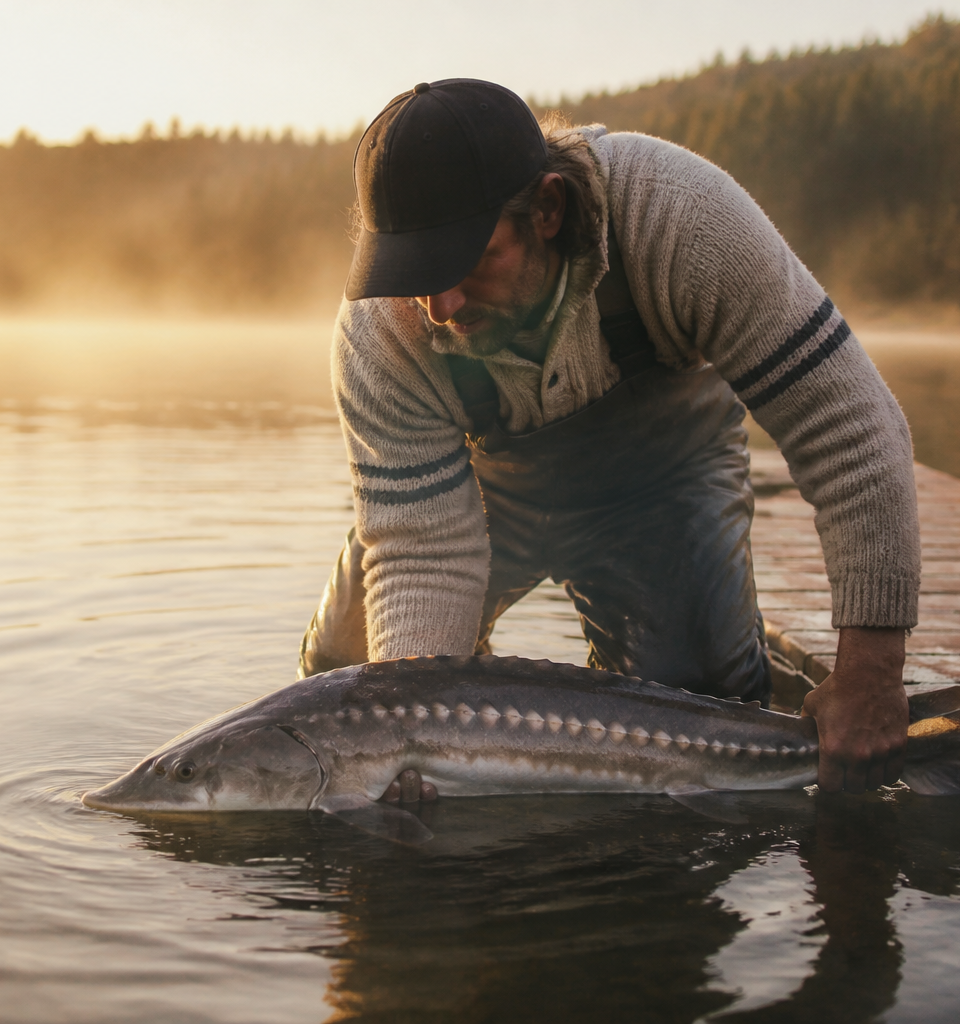
Species overview and identification
The lake sturgeon (*Acipenser fulvescens*) is one of North America's largest and oldest freshwater fish. A true living fossil dating back to the age of the dinosaurs, it is instantly recognizable by its largely cartilaginous skeleton and prehistoric profile. Its elongated body lacks traditional scales; instead, it is covered by five longitudinal rows of bony plates called scutes, which are sharply defined in young fish and smoother in mature adults.
Its massive head tapers into a conical snout with four flexible sensory barbels positioned just ahead of a downward-facing, protrusible mouth. This extendable mouth works like a vacuum to hoover up prey concealed in the sediment. Coloration ranges from olive-brown to slate-grey along the back, giving way to lighter flanks and a whitish belly. Its heterocercal tail fin—with an upper lobe distinctly larger than the lower—closely resembles that of a shark.
This giant of Quebec waters boasts remarkable longevity, exceeding 80 to 100 years under optimal conditions. It is slow-growing and reaches sexual maturity very late in life, making it a fascinating species that remains exceptionally vulnerable to outside pressures.
Habitat and geographic distribution
In Quebec, lake sturgeon are widely distributed throughout the major river systems of the south and west, as well as select northern watersheds. The St. Lawrence River serves as its most iconic habitat, particularly across wide fluvial expanses such as Lake Saint-Louis, Lake Saint-François, and Lake Saint-Pierre. Significant populations also inhabit the Ottawa River, Richelieu River, Rivière des Prairies, and several major drainage basins across Abitibi-Témiscamingue and Nord-du-Québec, including the Nottaway, Broadback, and Rupert river systems.
The species strongly favours large rivers and expansive lakes with shallow to moderately deep water. It primarily colonizes benthic zones where the substrate consists of sand, gravel, silt, or soft clay rich in organic matter.
While sturgeon spend most of their lives in calm deep pools and shipping channels, they seek out heavy currents, rocky rapids, and the bases of waterfalls during their spring spawning migrations.
Behaviour and seasonal patterns
Lake sturgeon behaviour is heavily dictated by water temperature, river flows, and spawning imperatives. In the spring, once water temperatures reach 10 to 15 degrees Celsius, mature adults undertake dramatic upstream migrations toward spawning grounds. They travel dozens, sometimes hundreds of kilometres to find gravel bars and boulder-strewn rapids swept by strong currents, where eggs can adhere without being suffocated by silt.
Once spawning wraps up, mature fish return to their summer feeding grounds. Throughout the warmer months, sturgeon settle into a strictly benthic routine. They cruise the bottom foraging for aquatic invertebrates, mayfly larvae, molluscs, small crustaceans, and dead or lethargic fish. Their tactile barbels and chemoreceptors sweep the substrate to pinpoint food with surgical precision.
In the fall, sturgeon feed heavily to build up energy reserves before winter. As water temperatures drop significantly, they gather in deep holes where currents slow down. Their metabolism drops considerably over the winter months, though they remain somewhat active.
Best seasons and conditions
Summer and early autumn offer the most productive windows for targeting lake sturgeon in Quebec, once the spawning closure has lifted and the regular season is open. From early July through late October, feeding activity is at its peak, especially during stable, warm weather patterns.
Lighting conditions strongly dictate your chances on the water. Low-light periods—such as dawn, dusk, and nighttime—coincide with distinct feeding surges as fish leave deep navigation channels to forage on shallower flats. Lightly turbid water or overcast skies similarly encourage fish to move and feed.
Water flow remains a critical factor. Sudden fluctuations in water levels caused by hydroelectric dams or heavy rainfall can throw fish off for several hours. Once flows stabilize, active feeding quickly resumes along clearly defined current seams.
Where and how to find it
Locating sturgeon consistently requires an eye for bottom structure and current dynamics. Transition zones between deep holes and sandy flats are prime real estate. Sturgeon routinely hold at the base of underwater drop-offs where current naturally deposits sediments and drifting food.
Key structural features to target include:
- Channel edges along commercial shipping lanes where the bottom drops steeply into deep water.
- Eddies and current seams downstream of islands or river narrows.
- River confluences where tributaries deliver nutrient-rich water.
- Broad silt flats positioned directly adjacent to heavy main-stem currents.
Modern sonar electronics will dramatically speed up your search. Lake sturgeon show up clearly on the screen as massive returns pinned right to the bottom or as distinct, heavy arches. Spotting a pod of fish clustered in a depression reliably indicates a key resting area or travel corridor.
Recommended techniques and strategies
Bottom fishing (still fishing with heavy sinkers) is the undisputed gold standard for catching lake sturgeon. This approach involves anchoring a heavy rig stationary right on the bottom where fish are patrolling. Boat anchoring must be rock-solid to prevent your rig from drifting and fouling in bottom debris.
The most effective setup is a sliding bottom rig (Carolina-rig style). A bell or pyramid sinker weighing between 80 and 250 grams (3 to 9 oz, depending on current strength) slides freely on the mainline above a rubber bumper bead and a heavy-duty barrel swivel. A short leader, typically 40 to 60 cm (16 to 24 inches), keeps the bait pinned close to the bottom without tangling.
When it comes to bait, bigger is better. Sturgeon rely heavily on their sense of smell to track down a meal. A massive ball of nightcrawlers (8 to 12 large worms threaded onto the hook) remains the benchmark bait in Quebec waters. Fresh cut bait—such as dead minnows, herring, or sucker meat—is also deadly. Sturgeon bites can be deceptively subtle given their size; they often start as slight rod-tip twitches before transitioning into a steady, heavy bend. Give the fish a few seconds to take the bait fully before setting the hook or letting the circle hook do its job.
Equipment and gear
Tackling an opponent that can exceed 1.5 metres (5 feet) and weigh dozens of pounds in heavy current demands rock-solid gear. Underpowered tackle risks break-offs and can overly exhaust a large fish during an extended fight.
A well-matched setup includes:
- A heavy-duty casting or spinning rod measuring 2.10 to 2.40 m (7 to 8 feet), Heavy or Extra-Heavy power, with a moderate-fast action to cushion powerful headshakes.
- A 4000 to 6000-size spinning reel or a sturdy conventional round reel featuring a smooth, powerful drag system rated for at least 8 to 10 kg (18 to 22 lbs).
- 50 to 80 lb braided mainline to slice through heavy current without creating excessive drag.
- A 50 to 60 lb abrasion-resistant fluorocarbon or monofilament leader.
- Non-offset circle hooks in sizes 3/0 to 6/0, which reliably hook the fish in the corner of the jaw and prevent deep gut-hooking.
- An extra-large knotless rubber landing net or, ideally, a purpose-built handling cradle to keep the fish secured in the water.
Regulations, licences and ethical practices
Lake sturgeon fishing is strictly regulated in Quebec to safeguard the sustainability of wild populations. Depending on the fishing zone, strict slot sizes and length limits are enforced to protect fast-growing juveniles and vital trophy-sized breeders. Precise catch limits and seasonal closures protect sturgeon during sensitive stages of their life cycle.
Ethical fish handling is essential on every single catch. If you are releasing a sturgeon, keep its time out of the water to an absolute minimum—ideally keeping the fish submerged alongside the boat while unhooking. Never hoist a sturgeon by the gills or tail without fully supporting its belly; their cartilaginous skeletons cannot support their own body weight out of the water.
To review current catch limits, exact opening dates, and specific zone regulations, visit the official website: Government of Quebec (hunting and fishing).
Regulations change annually: always verify the official rules before planning a trip.
Conservation, population and ecosystem role
Lake sturgeon play an essential ecological role across Quebec's freshwater ecosystems. As dominant benthic feeders, they help churn riverbed sediments and regulate populations of bottom-dwelling aquatic invertebrates. Their presence is a prime indicator of river connectivity and overall watershed health.
However, their life history makes them exceptionally fragile in the face of human activity. Female sturgeon do not reach sexual maturity until they are 15 to 25 years old, and they spawn only once every 3 to 5 years thereafter. This slow reproductive cycle means that the loss of mature breeding adults takes decades to recover.
Habitat fragmentation from hydro dams, siltation of spawning beds, and historical commercial overfishing took a heavy toll over the past century. Thanks to scientific monitoring, fish ladder installations, and angler education, several Quebec populations are showing encouraging signs of recovery and stability. Every angler directly supports conservation by practicing responsible catch-and-release.
Planning a guided trip or outfitter stay
Booking a guided sturgeon trip with an outfitter is one of the best ways to experience catching this river monster safely and effectively. The large waterways sturgeon call home feature powerful currents and complex bottom structure that demand seasoned navigation and precise anchoring skills.
Professional guides working with Quebec outfitters know the staging holes, prime tide stages, and peak bite windows inside and out. They provide properly matched heavy tackle and teach the correct handling and revival techniques needed to release these ancient giants unharmed.
Beyond access to prime, low-pressure waters, an outfitter stay pairs the thrill of the river with comfortable cabin accommodations and great meals shared after a long day on the water. It is an ideal adventure for families and friends looking to target a true trophy fish under expert guidance.
To find the right destination and book your next lake sturgeon adventure, plan your outfitter stay today on MyOutfitters.
Frequently asked questions
What is the best bait for lake sturgeon in Quebec?
A large ball of live nightcrawlers is the most versatile and effective bait. Threading 8 to 12 worms onto a circle hook creates a powerful scent trail. Fresh cut bait, such as sucker or herring chunks, is also very productive in river currents.
Why should you use circle hooks for sturgeon fishing?
Circle hooks roll and lock naturally into the corner of the fish's mouth as it pulls away. This prevents sturgeon from swallowing the hook deeply, protecting their vital organs and ensuring a safe, harm-free release.
What does a sturgeon bite feel like on the rod?
Despite their massive size, sturgeon bites are often surprisingly subtle. The rod tip typically twitches or taps repeatedly as the fish vacuums and tastes the bait on the bottom. Wait for a steady, heavy bend in the rod before lifting into the fish.
What time of day are sturgeon most active?
Sturgeon are most active in low-light conditions. Dusk, night, and early dawn offer the most productive fishing windows, as fish move out of deep holes to feed across shallower flats and channel edges.
How should you handle a large sturgeon to avoid injuring it?
Keep the fish in the water as much as possible. If lifting it briefly for a photo, support its weight horizontally with two hands—one under the belly and one near the tail wrist. Never hold a sturgeon vertically or touch its gills.
What line rating is recommended for sturgeon bottom fishing?
A 50 to 80 lb braided mainline is strongly recommended. It delivers the strength required to control heavy fish in current while keeping a thin diameter that cuts through the water, reducing current drag on your sinker.
Where do sturgeon hold in fast-flowing rivers?
Sturgeon hold in deep depressions on the riverbed, directly behind underwater points, or along the calm edges created by sudden drop-offs. These current breaks let them conserve energy while intercepting food carried by the main flow.
Why is late sexual maturity such a critical factor for sturgeon?
Females take 15 to 25 years to reach maturity and only spawn every 3 to 5 years. Harvesting a mature breeding female removes decades of reproductive capacity, making slot limits and ethical catch-and-release essential to their survival.
What is the difference between lake sturgeon and Atlantic sturgeon?
The Atlantic sturgeon is an anadromous species found primarily in the brackish and marine waters of the St. Lawrence estuary and grows significantly larger. The lake sturgeon lives strictly in freshwater and has a more rounded snout and lighter coloration.
What are the benefits of hiring an outfitter guide for sturgeon fishing?
An outfitter guide ensures safe anchoring in heavy river currents, provides proper heavy-duty tackle, and knows the exact travel routes fish use at different water levels. Guides also ensure proper handling so every fish is released in top condition.