Fishing
Coho Salmon Fishing in Ontario: The Complete Great Lakes Guide
Discover how to target Coho salmon across Ontario. Explore top Great Lakes tributaries, prime seasonal runs, effective gear, and expert tips for your next trip.
Key takeaways
- Coho salmon fishing peaks from late summer through late fall across the Great Lakes.
- Open waters on Lake Ontario and fast-flowing tributaries host the heaviest concentrations of migrating staging fish.
- Offshore downrigger trolling and casting heavy spoons in rivers remain the most effective methods.
- Every angler must carry a valid Ontario fishing licence with the appropriate sport or conservation tag.
- Plan outings on overcast days or during low-light hours at dawn and dusk when fish move toward shallower water.
How to identify Coho salmon in Ontario?
Coho salmon stand out with their dark mouths lined by distinct white gums along the lower jaw and their sleek, torpedo-shaped silver bodies. Unlike Chinook salmon, which have entirely black or dark grey mouths, the Coho displays this telltale pale gum line along the base of its teeth. In open water, their flanks flash a brilliant chrome sheen beneath a metallic blue or olive-green back dotted with small black spots primarily restricted to the upper body and the top lobe of the tail fin.
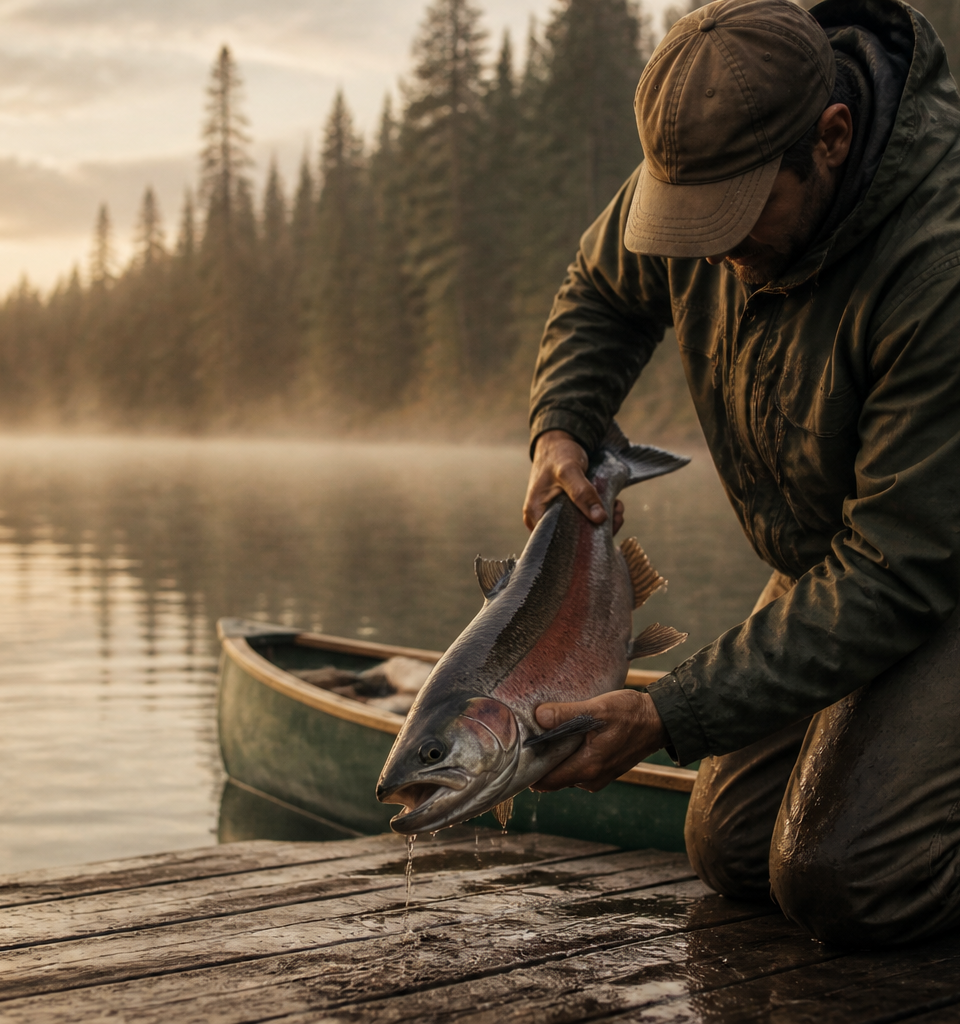
As autumn progresses and the river spawning run begins, Coho undergo a striking visual change. Males develop a hooked jaw called a kype along with deep maroon to brick-red colouring along their flanks and a dark dorsal surface. Females take on a more subdued yet distinct bronze or purplish hue. While anglers frequently compare catches during Chinook salmon fishing in Ontario: secrets and strategies, Ontario Coho typically average between 5 and 12 pounds, delivering exceptional pound-for-pound fighting power.
Coho salmon habitat and distribution in Ontario
Coho salmon thrive primarily throughout Lake Ontario, Lake Huron, and Georgian Bay. Introduced to expand sportfishing opportunities and manage prey species like alewife, Coho found ideal growing conditions in these vast freshwater systems. During the summer heat, these salmonids cruise the deep pelagic zones and offshore trenches where water temperatures remain cold and well oxygenated.
Key tributaries along the north and east shores of Lake Ontario, such as the Ganaraska River, Credit River, and Bowmanville Creek, serve as major migration corridors. While sport anglers often explore different fisheries through guides like 10 walleye fishing destinations to explore in Ontario, the Great Lakes watershed remains Ontario's premier salmon stronghold. Clean gravel-bottomed rivers lined with fast riffles and deep resting pools provide ideal habitat for the fall spawn.
Migratory behaviour and diet of Coho salmon
Coho salmon spend their open-water years feeding aggressively before making their final upstream run to natal spawning grounds. In pelagic zones, they gorge on baitfish including rainbow smelt, sculpin, and alewives. This protein-rich diet builds the energy reserves required to push through heavy river currents during spawning season.
By late summer, dropping water temperatures and seasonal rains prompt Coho to stage near river mouths and harbour mouths. Once entering rivers, they largely stop feeding and shift focus to reproduction, yet they retain intense territorial aggression. This instinct drives them to strike hard at lures, spoons, and flies that swing through their holding lies.
When to fish for Coho salmon in Ontario?
The prime window for targeting Coho salmon runs from mid-August through late November across Ontario. Throughout August, offshore trolling produces fast action as staging schools gather outside tributary mouths. September and October represent the peak period for riverbank and wading anglers pursuing fresh, energetic runs entering coastal streams.
Weather conditions strongly dictate fishing success. Passing rain systems that boost river flows and add a slight stain to the water trigger mass upstream pushes. Overcast days or low-light conditions at sunrise and sunset encourage staging Coho to leave deep timber and negotiate river riffles, making them far more willing to hit presentations.
Where to find Coho salmon in Ontario waterways
Locating Coho in river systems requires working current seams between fast runs and calm water. Holding pools directly below impassable waterfalls, deep river bends carved by heavy current, and slack-water pockets behind large boulders are prime staging lies. Coho also hold tightly against sunken timber and log jams that offer security from overhead pressure.
On the open lake, pinpointing the thermocline using sonar is essential. Coho generally cruise the upper, warmer layer of the water column compared to lake trout or mature Chinook, often holding between 30 and 70 feet deep in midsummer. Locating dense schools of baitfish like smelt and alewife is the fastest way to zero in on roaming pods of active salmon.
Best techniques for catching Coho salmon
Downrigger trolling and planer board spreads remain standard for covering water effectively on the Great Lakes. Flutter spoons and trolling spoons in silver, glow, green, and chartreuse patterns imitate fleeing baitfish. In certain conditions, anglers can also adapt active methods similar to those found in Forget the downrigger: When Coho salmon hit the surface in B.C. to capitalize on early morning surface activity.
In river systems, casting heavy inline spinners or jointed crankbaits triggers explosive reaction strikes. Float fishing with natural roe bags, fluorescent beads, or yarn flies drifted through deeper holding pools is equally deadly for finicky fish. For fly anglers, swinging large streamers and bunny leeches on sink-tip lines through current seams regularly provokes aggressive territorial takes from mature fish.
Essential tackle and gear for Coho salmon fishing
A medium-heavy action rod between 8'6" and 10'6" gives anglers the leverage needed to steer powerful Coho away from river snags. Pair it with a smooth spinning or centerpin reel featuring a dependable drag, spooled with at least 200 yards of 12- to 17-pound monofilament or equivalent braided line with a fluorocarbon leader.
For boat trolling, stout trolling rods with line-counter reels ensure consistent lure depths along the thermocline. Build a tackle selection featuring trolling spoons, dodgers, fly combos, and crankbaits in various metallic and UV finishes. Breathable chest waders, a large rubber-mesh landing net, and polarized sunglasses are essential gear for wading coastal tributaries.
Coho salmon fishing regulations in Ontario
Coho salmon angling is regulated by specific Fisheries Management Zones (FMZs) across the province. Daily catch and possession limits, seasonal fish sanctuaries, and gear restrictions (such as barbless hooks or artificial-only rules) vary depending on the waterbody and season. Always consult the official regulations through the Government of Ontario before planning your outing.
Responsible fish handling ensures sustainable fisheries for future seasons. When releasing salmon, minimize out-of-water exposure, keep your hands wet, and hold the fish upright facing into the gentle current until it regains enough strength to swim off freely. Regulations change annually: always verify current catch limits, open seasons, and fish sanctuaries with official authorities before heading out.
Ecological role and conservation of Coho salmon
Since their introduction, Coho salmon have filled an important predatory role within the Great Lakes ecosystem. They assist in balancing introduced forage fish populations like alewives while transferring vital ocean-like marine nutrients to freshwater river banks during the fall run. Spent carcasses decompose in upstream spawning reaches, feeding aquatic macroinvertebrates and sustaining river health.
Targeted stocking efforts supported by local conservation clubs, hatcheries, and volunteers help maintain dependable populations. Habitat restoration projects, improved stream bank protection, and fish ladder installations remain critical for wild spawning success. Anglers play an active role in stewardship by respecting limits and practicing clean catch-and-release techniques.
Planning a guided Coho salmon fishing trip
Booking a professional outfitter or charter captain is one of the most effective ways to master Ontario salmon waters. Experienced guides know the daily movements of migrating schools, have access to prime river beats and open-water hotspots, and supply specialized tackle suited to current conditions.
Charter operations and riverside lodges provide complete packages including accommodations, fully rigged boats, and fish cleaning services. To find certified guides and top-tier lodges in prime salmon country, explore Ontario fishing outfitters and plan your next Great Lakes adventure with MyOutfitters.
Frequently asked questions
When does the Coho salmon run start in Ontario?
The Coho salmon run generally starts staging near Great Lakes river mouths in late August. Peak river action takes place between mid-September and late October, when cooler water and fall rainstorms trigger upstream movement toward gravel spawning beds.
Where can you wade for Coho salmon on Lake Ontario?
Top wading locations are found along Lake Ontario's north shore tributaries, including the Credit River, Ganaraska River, and Bowmanville Creek. These systems feature numerous public access points with deep holding pools and gravel runs suitable for float fishing, spin casting, and fly fishing.
What is the difference between Coho salmon and Chinook salmon?
Coho salmon have distinct white gums along their lower teeth, whereas Chinook salmon have solid dark grey or black mouths and gums. Additionally, Coho typically feature black spots only on the upper half of their tail fin, while Chinook display spots across the entire tail.
What lures work best for Coho salmon in rivers?
Heavy inline spinners like Mepps or Blue Fox in chartreuse, orange, and silver finishes are proven river producers. Deep-diving crankbaits and drifted bead or roe presentations beneath a float are also highly effective at triggering aggressive territorial bites.
Do you need a special licence for Coho salmon in Ontario?
There is no separate salmon stamp required, but you must hold a valid Ontario Outdoors Card along with a Sport Fishing or Conservation Fishing Licence tag. Non-residents require appropriate Ontario non-resident licences and must adhere to regional possession limits.
What is the average weight of a Coho salmon caught in Ontario?
Coho salmon caught in Ontario waters typically weigh between 5 and 10 pounds. Larger mature specimens pushing 12 to 15 pounds are regularly taken late in the fall after seasons of feeding on Great Lakes baitfish.
What fishing rod should you choose for Coho salmon?
A 9-foot to 10'6" medium-heavy spinning or centerpin rod provides the right balance for river fishing. It delivers long casts, cushions the acrobatic jumps of hooked Coho, and provides sufficient backbone to steer fish away from heavy structure.
Why does Coho salmon change colour in the fall?
The colour shift is triggered by hormonal changes as salmon reach sexual maturity and enter freshwater to spawn. They lose their bright silver open-water coat and take on maroon, deep red, or bronze tones, while males develop a pronounced hooked kype.
Can you fly fish for Coho salmon in Ontario?
Fly fishing is very effective during the fall run on shallow Great Lakes tributaries. A 7- or 8-weight single-hand or switch rod rigged with a sink-tip line and bright streamers, egg patterns, or woolly buggers works well in deeper pools and runs.
How can you maximize survival rates for released Coho salmon?
Use a knotless rubber landing net and keep the fish in the water as much as possible. Keep fight times short using appropriately heavy line, handle the fish only with wet hands, and hold it gently facing into the current until it swims away under its own power.