Fishing
Walleye Fishing in Quebec: Complete Guide for a Successful Outing
Master walleye fishing in Quebec with expert tips: seasonal behaviour, key structures, essential lures, and proven presentation strategies.
Species overview and identification
Walleye is undeniably one of the most iconic and sought-after sport fish across Quebec's waterways. Belonging to the Percidae family, it is represented in the province by two distinct species: yellow walleye (*Sander vitreus*) and sauger (*Sander canadensis*). Its delicate, flaky flesh makes it a premier table fare for outdoor gastronomy enthusiasts, while its natural wariness and schooling habits offer a compelling challenge on the water.
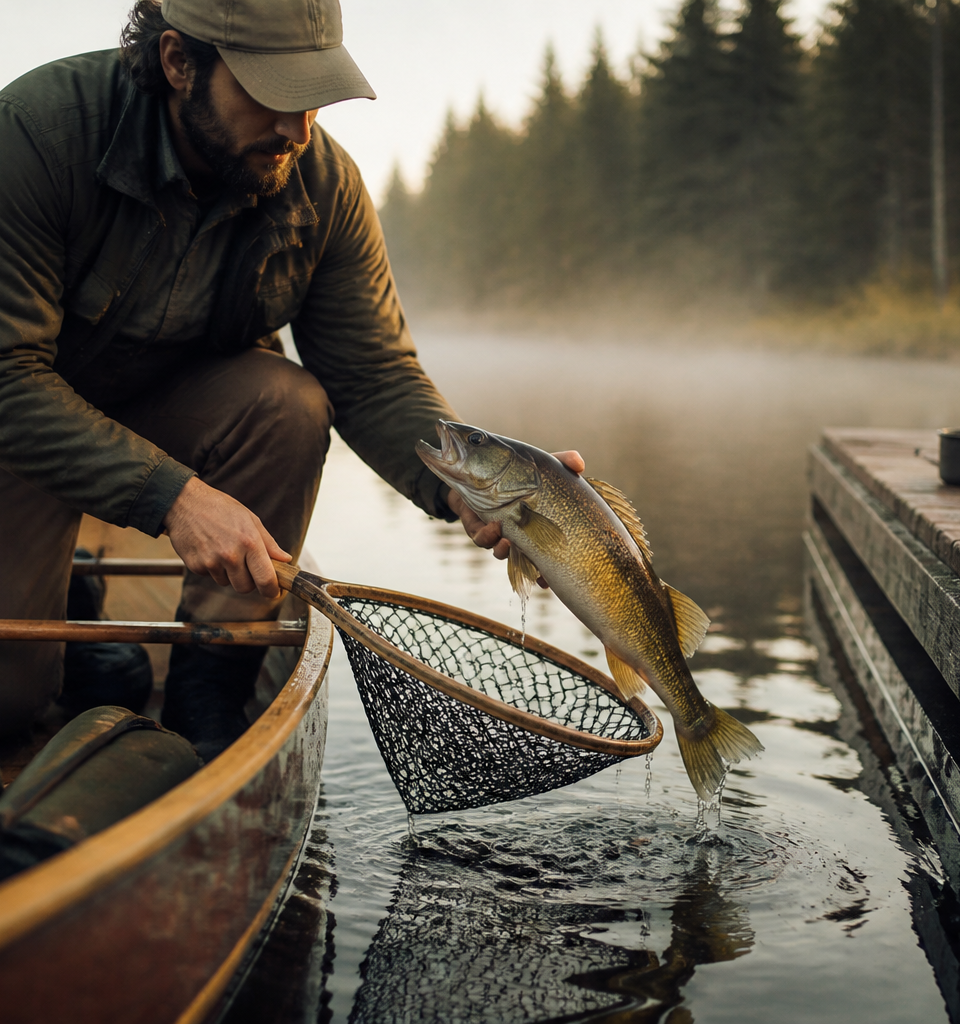
To properly identify yellow walleye, first examine its overall colouration, which ranges from olive-green to brassy gold on the flanks with a clean whitish belly. Its most definitive hallmark is the bright, distinct white spot on the lower tip of the caudal (tail) fin, accompanied by a solid dark blotch at the rear base of its first spiny dorsal fin. Its large, glassy eyes feature a specialized reflective membrane called the *tapetum lucidum*, providing exceptional night vision adapted for hunting in dark, stained waters.
Sauger, by contrast, has a slightly stockier build and duller colouration, often marked by distinct dark mottling or saddles across its body. Its dorsal fin is patterned with neat rows of small black spots, and it entirely lacks the white tip on the lower tail fin found on yellow walleye. Sauger generally shows a higher tolerance for turbid water and stronger current flows.
Habitat and geographic distribution
In Quebec, walleye is widely distributed throughout southern, central, and western hydrographic basins. It thrives in high numbers across the St. Lawrence River, Ottawa River, Lake Saint-Pierre, as well as legendary wilderness waters like the Gouin, Cabonga, Dozois, and Pipmuacan reservoirs. The regions of Abitibi-Témiscamingue, Outaouais, Laurentides, Mauricie, Saguenay–Lac-Saint-Jean, and Eeyou Istchee Baie-James also support exceptional walleye densities.
This predator shows a strong preference for large, coolwater lakes, slow-to-moderate rivers, and expansive hydroelectric reservoirs dotted with islands, bays, and rocky structure. It thrives in aquatic environments featuring slight turbidity or the classic tea-stained amber water of the Canadian Shield, which cuts direct solar penetration and maximizes the efficiency of its light-sensitive eyes.
At a local level, walleye positioning is strictly governed by forage availability and shade. Hard bottoms composed of gravel, cobble, broken rock, and sand serve as primary feeding areas, especially near sudden depth transitions and submerged weedlines.
Behaviour and seasonal patterns
Walleye behaviour changes noticeably across Quebec's seasons, driven by water temperatures, spawning cycles, and the migrations of primary forage species.
- Spring: Right after ice-out, walleye congregate in river tributaries, below rapids, or along wave-swept rocky shoals to spawn once water temperatures reach 4 to 8 degrees Celsius. Following the spawn, post-spawn fish linger in shallow flats and warming bays to recover, feeding actively on small forage fish.
- Summer: As surface layers warm, fish transition toward deeper structure, often holding along or just above the thermocline. On bright sunny days, they stay glued to the bottom or buried inside thick weedbeds, migrating up onto shallow rock humps and flats at dusk to feed.
- Fall: Dropping water temperatures trigger the die-off of shallow weeds, pushing walleye into dense schools along major deep-water structures. This is a prime fall feeding frenzy where fish strike large baits to build up winter fat reserves.
- Winter: Under the ice, walleye metabolism slows down, yet fish continue feeding consistently along sharp breaklines, submerged points, and deep, quiet holes.
Best seasons and conditions
The most productive periods for targeting walleye in Quebec span from late spring to early summer, followed by a second peak from late August until the first hard frosts of autumn. The spring opener offers fast-paced shallow-water action, while the autumn months are famous for producing trophy-class fish.
Weather conditions directly impact walleye activity. Overcast, drizzly, and windy days consistently produce the finest fishing. The surface chop created by wind—often called the "walleye chop"—diffuses light penetration, giving walleye the confidence to cruise shallow structure and hunt aggressively.
Conversely, during bright, calm, high-pressure days, walleye tend to turn sluggish or retreat deep into structural shade. Feeding windows during these bluebird periods narrow down almost entirely to dawn, the final hour before sunset, and into the night.
Where and how to find it
Successfully locating walleye on Quebec waters relies on reading underwater contours and identifying depth breaks that funnel current and baitfish.
- Extended rock points: Main-lake points and underwater rock ridges extending toward deep basins act as natural travel corridors for roving schools.
- Drop-offs and transition zones: Steep breaklines falling from 4 to 8 metres, especially where bottom composition shifts from rock to mud or gravel to sand, consistently hold fish.
- Submerged humps and offshore reefs: Rising from deeper basins, isolated underwater shoals attract walleye at first and last light.
- Inflows and current seams: Walleye sit right along current edges near rapids, using bottom boulders and eddies as ambush points to intercept drifting baitfish.
- Green cabbage and milfoil beds: In early summer, lush, submerged weed edges offer shade, high dissolved oxygen, and an abundance of forage.
Using sonar alongside bathymetric mapping makes this search far more efficient by pinpointing the exact depth at which schools are suspended or pinned to the bottom.
Recommended techniques and strategies
Vertical jigging remains the go-to presentation for fooling Quebec walleye. It consists of working a leadhead jig tipped with a soft plastic or live bait just inches above bottom. Precision is key: snap the rod tip upward with a controlled wrist flick, then maintain light tension on the drop without leaving slack line, as the vast majority of strikes occur as the jig falls.
Bottom bouncing with a spinner-and-worm harness is an unbeatable strategy for covering expansive areas and locating scattered fish. The wire-arm weight should tick the bottom periodically while the spinning blade emits strong flash and vibration at low trolling speeds, ideally between 1.0 and 1.5 knots.
For fish positioned along shallow weed edges or shallow rock points, casting and retrieving slender jerkbaits or vibrating blade baits yields fast action, particularly during the twilight window when walleye push high into the water column.
Equipment and gear
Tackle selection should balance sensitivity, lightweight handling, and fast action to detect subtle bites. A quality spinning setup is the primary choice for most Quebec walleye techniques.
- Rod: A 6'6" to 7'0" high-modulus graphite spinning rod, Medium-Light or Medium power with Fast action for crisp hooksets.
- Reel: A 2500-size spinning reel spooled with 8 to 12 lb test braided mainline, providing high sensitivity and zero stretch on hooksets.
- Leader: A stealthy 8 to 10 lb fluorocarbon leader roughly 1.5 metres in length, tied to the braid via a double uni or FG knot.
- Jig heads: An assortment of heads from 1/8 oz to 1/2 oz to match depth and current, in high-contrast colours such as pearl white, chartreuse, fluorescent yellow, orange, and pink.
- Soft plastics: 3- to 5-inch minnow-profile paddletails, ribbed worms, and curly-tail grubs in natural baitfish patterns, white, motor oil, or glow finishes for stained water.
- Hardbaits and spinners: Slender 9 to 12 cm diving minnow plugs, inline spinners, and worm harnesses fitted with hammered gold, copper, or nickel blades.
Regulations, licences and ethical practices
Sport fishing in Quebec is managed through strict conservation regulations to safeguard the fishery. Anglers must carry a valid Quebec sport fishing licence and adhere closely to designated open seasons, daily bag limits, and possession limits specific to the fishing zone visited.
In most Quebec fishing zones, yellow walleye and sauger are subject to a slot size limit (protected length window). Anglers must immediately release any walleye measuring under the minimum limit or over the maximum limit. This measure protects juvenile fish before their first spawn while preserving the large breeding females vital for population sustainability.
Proper handling of fish slated for release is essential. Use a knotless rubber net, wet your hands before touching the fish, avoid vertical jaw holds, and minimize out-of-water exposure. When fishing deeper than 8 to 9 metres, retrieve catches slowly to minimize the risk of barotrauma.
For comprehensive rules, zone maps, and waterbody-specific exceptions, consult the official publications from the Government of Quebec (hunting and fishing). Regulations change annually: always verify the official rules in effect for your zone before heading out.
Conservation, population and ecosystem role
Walleye serves as a key apex predator in Quebec's freshwater systems. By regulating populations of yellow perch, suckers, sunfish, and minnows, it helps sustain balanced and healthy aquatic ecosystems.
Increased fishing pressure, climate fluctuations, and the vulnerability of spawning habitats require thoughtful stewardship from anglers. Large female walleye, often more than a decade old, produce significantly higher volumes of high-viability eggs. Adopting selective harvest—keeping smaller legal fish for a meal while releasing trophy breeders—secures strong natural recruitment.
Anglers can support conservation by following clean-drain-dry protocols on boats and trailers to prevent the introduction of aquatic invasive species, keeping shorelines clean, and respecting protected spawning sanctuaries.
Planning a guided trip or outfitter stay
For a premier walleye fishing adventure, a stay at a Quebec outfitter provides an unmatched experience. These managed wilderness territories grant access to productive lakes and rivers with low fishing pressure, set against the backdrop of vast boreal landscapes.
Booking a professional outfitter guide significantly shortens the learning curve on new water. With an intimate grasp of local drop-offs, seasonal movements, and feeding habits, guides position you on prime fishing grounds while sharing key technical refinements to trigger cautious fish.
Whether you prefer the full-service comfort of an American plan main lodge or the privacy of a remote European plan outpost cabin on an isolated island, Quebec outfitters cater to every style. Discover top destinations and book your next outfitter walleye fishing adventure directly on MyOutfitters.
Frequently asked questions
How do you distinguish a yellow walleye from a sauger in the field?
The quickest and most reliable identifier is the tail fin: yellow walleye features a distinct white patch on the lower tip of its caudal fin, which sauger lacks. Additionally, a sauger's dorsal fin is patterned with distinct rows of small black spots.
Why does wind create better conditions for walleye fishing?
Wind creates surface chop that breaks up sunlight penetration. Because walleye have eyes that are sensitive to bright light, this reduced light level allows them to move up into shallow water to feed aggressively on baitfish disoriented by wave action.
What are the best times of day to catch walleye?
Low-light periods produce the highest catch rates, particularly dawn, dusk, and the first few hours after dark. On bright, sunny days, focus on deeper drop-offs or shaded edges of dense cabbage beds where walleye seek cover.
How can you prevent barotrauma when releasing walleye?
To prevent fatal swim bladder expansion, avoid fishing at depths greater than 8 to 9 metres if you plan to release your catch. If catching fish from deep water, reel them in slowly and release them quickly after proper revival.
What line setup is best for walleye jigging?
An 8 to 12 lb test braided mainline is ideal because its lack of stretch provides immediate bite detection and solid hooksets. Pair it with a 1.5-metre leader of 8 to 10 lb fluorocarbon for abrasion resistance around rocks.
What is the purpose of slot size limits across Quebec fishing zones?
Slot size limits protect young walleye so they can spawn at least once, while also safeguarding the largest mature females that produce the highest quality eggs. This practice sustains natural reproduction and healthy stock levels.
Which soft plastic lure colours work best in Quebec waters?
In stained or dark waters typical of the Canadian Shield, high-visibility colours like chartreuse, fluorescent orange, pink, pearl white, and glow finishes perform best. In clear water, natural baitfish patterns, perch tones, olive green, and motor oil work well.
Can you successfully ice fish for walleye during winter?
Yes, ice fishing for walleye is very popular throughout Quebec. It is primarily done by vertical jigging with small vibrating spoons, balance jigs (jigging minnows), or baited tip-ups positioned over rock humps and deep breaklines, particularly around sunrise and sunset.
How do you locate the thermocline to find summer walleye?
In mid-summer, walleye frequently suspend near or right along the thermocline—the temperature transition layer between warm surface water and cold deep water. It can be located on a tuned sonar unit where it appears as a faint, continuous horizontal band created by the water density difference.
Why book a guided outfitter trip for walleye in Quebec?
Outfitter stays provide access to exclusive or remote waters with minimal fishing pressure and healthy fish populations. Fishing alongside a professional local guide helps you quickly identify key structural features and hone the exact techniques suited to the lake.