Fishing
Landlocked Salmon Fishing in Quebec: Complete Guide and Techniques
Discover how to target hard-fighting landlocked salmon (ouananiche) in Quebec: key habitats, trolling strategies, optimal gear, and tips for a memorable trip.
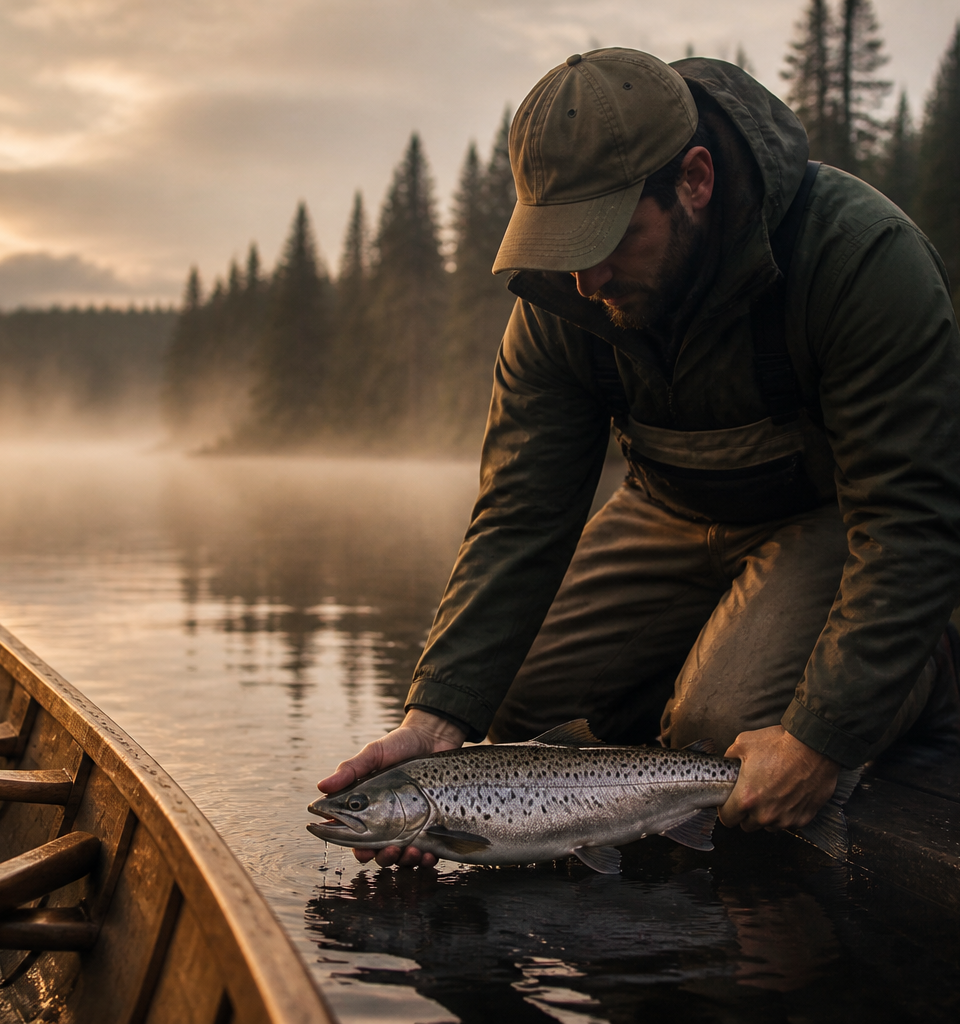
Species overview and identification
Ouananiche—an Innu word meaning "the little lost one"—is the freshwater form of the Atlantic salmon (Salmo salar sebago). Naturally landlocked in Quebec's major watersheds following the retreat of the glaciers, it has retained all the spirit, power, and elegance of its anadromous ancestor. It is undisputedly one of the most spectacular and combative freshwater game fish in our territory, renowned for its acrobatic leaps the instant the hook is set.
Anatomically, landlocked salmon feature a streamlined, torpedo-shaped body built for open-water speed. Its silvery flanks are peppered with small, distinct black cross-shaped or X-shaped spots, concentrated primarily above the lateral line. It has a broad, deeply forked caudal fin supported by a slender yet remarkably muscular caudal peduncle. Unlike brook trout or lake trout, its mouth is moderately cleft and does not extend past the rear edge of the eye, except in mature spawning males with a developed kype.
It is sometimes confused with other salmonids, notably brown trout or rainbow trout. However, its more uniform coloration, the absence of blue-haloed red spots, and the presence of clear black markings on the gill cover (operculum) allow for unmistakable identification. Its delicate pink-orange flesh is highly prized by boreal culinary enthusiasts.
Habitat and geographic distribution
Landlocked salmon require cold, clear, and highly oxygenated waters to thrive. They are primarily found in vast, deep oligotrophic lakes and major river networks across Quebec. These expansive bodies of water provide sufficient biomass, particularly forage fish, to support the rapid growth of this pelagic predator.
Historically, the Lac Saint-Jean basin and its major tributaries—such as the Péribonka, Ashuapmushuan, and Mistassini rivers—serve as the species' legendary cradle. However, its range extends across several other iconic regions of the province. Thriving populations inhabit the deep lakes of the Eastern Townships (notably Lake Memphremagog), multiple reservoirs in Mauricie, large waterbodies in the Laurentians and Outaouais, as well as wild river and lake systems across the Côte-Nord and Saguenay regions.
The defining element of its habitat remains a pronounced summer thermal stratification paired with a steady, accessible pelagic forage base. Deep lakes with expansive basins and vigorous feeder streams offer the ideal ecosystem for ouananiche to complete their entire life cycle without ever migrating to the ocean.
Behaviour and seasonal patterns
Landlocked salmon behaviour is closely tied to water temperatures and the movements of their preferred prey in Quebec: rainbow smelt. As ice melts in spring, when surface waters remain cool and uniform between 8 and 12 degrees Celsius, ouananiche actively cruise the lake's top layer—often within the upper three metres of the water column—hunting smelt along shorelines and river mouths.
As summer sets in and surface waters warm, lakes undergo thermal stratification. Ouananiche retreat from warm surface layers to drop beneath the thermocline, settling into a thermal comfort zone typically between 10 and 14 degrees Celsius. During this period, they often suspend at depths ranging from 12 to 25 metres, shadowing forage schools off rocky points and over deep open basins.
In autumn, the biological cycle shifts toward spawning. With cooling water and the fall turnover, mature adults stage around river mouths or run directly up fast-flowing, gravel-bottomed streams. Their territorial aggression spikes considerably, offering anglers unique river-fishing opportunities before winter arrives.
Best seasons and conditions
Spring is prime time for many Quebec anglers. From ice-out until mid-June, feeding activity peaks. Landlocked salmon are hungry after the winter lull and hunt aggressively near the surface. This is the ideal window for visual, action-packed fishing using light trolling setups or boat-based light casting.
Summer remains highly productive provided you adapt your depth strategy. July and August demand tracking the thermocline with specialized gear. Early morning outings right at first light or late-evening runs often produce the best summer bites once conditions settle.
Weather-wise, cool, overcast days with a light chop on the surface are ideal. Ouananiche possess sharp eyesight and are wary in mirror-calm waters under bright sun. Cloud cover combined with moderate wind diffuses light penetration, encouraging these predators to feed actively and commit with confidence.
Where and how to find it
Locating landlocked salmon on large Quebec lakes requires reading underwater structure and bathymetry. Prominent geological features make prime targets: rocky points extending into deep bays, isolated humps and underwater reefs surrounded by deep basins, and natural narrows where wind channels current.
River mouths and deltas are key staging areas, especially in spring when rainbow smelt gather to spawn, or after heavy rainfalls wash down nutrients. Pay close attention to wind direction: windward, wave-beaten shorelines accumulate plankton, attracting baitfish and, inevitably, apex pelagic predators.
Using your sonar effectively is a game-changer on big water. Rather than searching for single large fish arches, focus on spotting dense baitfish clouds. Once you locate these balls of smelt at a specific depth, you have pinpointed the active feeding zone where you should focus your trolling passes.
Recommended techniques and strategies
Controlled-depth trolling remains the most popular and productive method for covering vast expanses of water. It allows you to run multiple lines at varying depths and setbacks to dial in the day's winning pattern.
Key techniques for targeting ouananiche include:
- Surface trolling in spring using planer boards to pull lures wide of the boat's wake, preventing spooking in clear water.
- Downriggers or bottom-bouncers in midsummer to keep fluttering spoons or minnowbaits running precisely through the thermocline.
- Leadcore line or copper wire setups to achieve intermediate depths with a natural, undulating swimming action.
- Fly fishing with streamer patterns in rivers or drifting along shoals, stripping smelt imitations with sharp, erratic jerks.
Trolling speed is critical: landlocked salmon thrive on fast, aggressive presentations. A speed between 3.5 and 5.5 km/h (2.2 to 3.5 knots) frequently triggers violent reaction strikes that static or slow lures simply fail to elicit.
Equipment and gear
Tackle must be tuned to handle blistering runs and repeated aerial leaps. A rod that is too stiff will pull hooks during high-flying jumps, while an overly soft rod will lack the backbone for a solid hookset.
For trolling setups, focus on:
- A 7'6" to 8'6" medium-power rod with a moderate or moderate-fast parabolic action to cushion surges.
- A line-counter reel, essential for duplicating productive setback distances and depth zones accurately.
- Mainline of 15 to 20 lb braid or premium 10 to 12 lb monofilament for added stretch and shock absorption.
- An invisible 8 to 10 lb fluorocarbon leader measuring at least 2 to 3 metres (6 to 10 feet).
For lures, thin, lightweight fluttering spoons in silver, copper, or metallic blue finishes are staples across Quebec waters. Slender 7 to 11 cm stickbaits mimicking smelt profiles and tandem trolling flies (streamers) tied on tandem hooks are among the most dependable options in your tackle box.
Regulations, licences and ethical practices
Fishing for landlocked salmon in Quebec is subject to strict management to sustain wild populations. Each fishing zone features its own open and close dates, as well as distinct daily catch and possession limits that can vary significantly between waterbodies.
All anglers must carry a valid Quebec sportfishing licence. On certain lakes, designated rivers, or ZECs (controlled harvesting zones), daily access rights or specific catch registrations are mandatory. In addition, several river stretches enforce gear restrictions, such as single-hook barbless fly-fishing only.
To review all regulations applicable to your destination, consult the official guidelines from the Government of Quebec (hunting and fishing). Regulations change annually: always check official rules before heading out.
Conservation, population and ecosystem role
As an apex predator in northern lake systems, landlocked salmon play a critical ecological role. They help maintain balanced forage fish communities and act as sensitive bioindicators of water quality and overall watershed health.
Wild populations face challenges from altered flow regimes in spawning tributaries, siltation of gravel beds, aquatic invasive species, and prolonged thermal stress driven by climate change. To preserve viable stocks, wildlife managers and regional groups across Quebec conduct habitat restoration, fish-passage management, and selective stocking programs.
Practising ethical catch-and-release is vital, especially during warm summer months. Use a knotless rubber landing net, keep air exposure under a few seconds, and avoid lifting fish by the jaw. Taking time to properly revive your catch facing into the current before release ensures this iconic sportfish continues to thrive in Quebec's waters.
Planning a guided trip or outfitter stay
Targeting ouananiche at a Quebec outfitter is the ultimate adventure for any sport angler. Outfitter operations situated on expansive boreal lakes provide seaworthy boats equipped with cutting-edge electronics (GPS fishfinders, electric downriggers, silent kicker motors) built to handle big open waters.
Hiring a local professional guide elevates the entire trip. A seasoned guide knows seasonal travel corridors, daily thermocline fluctuations, and which lure colours produce best in varying light and water clarity. Beyond maximizing catch rates, they ensure safe navigation on large, unpredictable northern waters.
Whether you prefer the comfort of a full-service wilderness lodge with gourmet regional meals or the quiet independence of a lakeside housekeeping cabin, Quebec's outfitter network offers tailor-made packages for every angling style. To find your ideal destination and book your next landlocked salmon adventure with confidence, explore the vetted options on MyOutfitters.
Frequently asked questions
What is the main difference between landlocked salmon (ouananiche) and sea-run Atlantic salmon?
Landlocked salmon are genetically Atlantic salmon, but they complete their entire life cycle in freshwater without migrating to the ocean. They generally reach a smaller maximum size due to lacustrine food resources while retaining all the acrobatics and aggression of their sea-run relatives.
What is the best trolling speed for landlocked salmon?
Ouananiche respond exceptionally well to fast presentations. A trolling speed between 3.5 and 5.5 km/h (approx. 2.2 to 3.5 knots) is ideal for triggering reaction strikes and discouraging slower-moving species.
What are the best lures to start trolling for ouananiche?
Thin, light fluttering spoons in silver, blue, or copper finishes, alongside slender 7 to 9 cm minnowbaits mimicking rainbow smelt, are among the most versatile and productive choices on Quebec lakes.
How do you catch landlocked salmon in the heat of summer?
In July and August, target the thermocline between 12 and 25 metres deep using downriggers or leadcore line. Focus your efforts at first light or near dusk around deep-water humps, points, and basins.
Can you fly fish for landlocked salmon in Quebec?
Yes, absolutely. Fly fishing is very effective in spring along shallow lake drop-offs and in autumn when fish enter spawning rivers. Large tandem streamers like the Grey Ghost or Magog Smelt stripped with fast, erratic pulses yield great results.
What rod power and action is best for preventing lost fish?
Choose a medium-power rod with a moderate or semi-parabolic action. A forgiving tip absorbs powerful headshakes and acrobatic jumps, preventing hooks from tearing free during the fight.
Why is the presence of rainbow smelt so critical?
Rainbow smelt are the primary food source for adult landlocked salmon in Quebec lakes. Ouananiche movements, holding depths, and overall population health are directly governed by smelt abundance and distribution.
How should you properly handle a landlocked salmon for catch-and-release?
Use a knotless rubber net, keep the fish in the water as much as possible, handle it only with wet hands, and avoid squeezing its belly or gripping the jaw alone. Gently revive it upright facing into the current until it swims off under its own power.
Is wind a positive factor for landlocked salmon fishing?
Yes, a moderate breeze that generates a surface chop is ideal. Wind diffuses bright sunlight, lowers fish wariness, and pushes plankton and baitfish toward windblown shorelines, creating prime feeding lanes.
What are the main benefits of booking a guided ouananiche trip at an outfitter?
An outfitter guide understands local water dynamics, tracks the daily thermocline, and knows active fish travel routes. They also supply specialized big-water boats rigged with downriggers and modern electronics, maximizing both your safety and fishing success.