Fishing
Lake Trout / Charr Fishing in Saskatchewan: Coldwater Giants Guide
Discover the secrets of Lake trout / charr fishing in Saskatchewan: boreal habitats, prime seasons, proven techniques, and guided wilderness lodge trips.
Key takeaways
- From ice-out in May through late September, predators feed aggressively across northern Saskatchewan.
- Massive coldwater Canadian Shield lakes like Wollaston and Athabasca hold prime trophy specimens.
- Deep trolling with lead core line in summer and shallow casting in spring yield excellent results.
- Securing a provincial fishing licence and following possession limits are strict mandatory legal requirements.
- Equip yourself with quality sonar and heavy silver spoons to target deep-water baitfish schools.
Identifying Lake trout / charr in northern lakes
Lake trout / charr stands out with its torpedo-shaped body, deeply forked tail, and pale spots scattered over a dark background. Unlike other charr, it lacks blue-haloed red spots, featuring coloration ranging from silvery grey to deep olive green instead. Its lower fins have a delicate white leading edge without the distinct black accent line seen on brook trout.
This native species, scientifically known as *Salvelinus namaycush*, is ideally adapted to crystal-clear boreal waters. Its growth is exceptionally slow due to the frigid water temperatures it inhabits year-round, making every mature fish truly remarkable. A ten-pound fish has often spent over fifteen years patrolling deep lake basins.
Its hydrodynamic build and powerful jaws lined with sharp teeth make it a formidable apex predator in northern aquatic food webs. If you have already tried Lake trout / charr fishing in the Northwest Territories, you will find the same legendary fighting power and explosive strikes in Saskatchewan's coldwater fisheries.
Where does Lake trout / charr live in Saskatchewan?
Lake trout / charr primarily inhabits the northern half of Saskatchewan, where the Canadian Shield forms vast, deep, oligotrophic lake systems. It thrives in world-renowned waters such as Lake Athabasca, Wollaston Lake, Reindeer Lake, Cree Lake, and Lac La Ronge. These pristine wilderness lakes frequently reach depths exceeding 50 metres, crucial for the species' survival.
These boreal waters feature exceptional clarity, low aquatic vegetation, and high dissolved oxygen levels throughout the entire water column. Lake trout / charr finds complex structure here—steep drop-offs, submerged reefs, and wind-swept rocky shoals—where it hunts lake whitefish, cisco (tullibee), and sculpin.
In the southern part of the province, shallow prairie lakes do not satisfy its strict thermal requirements. A few deep southern reservoirs have hosted stocked populations in the past, but the authentic wild fishery remains firmly rooted in the northern taiga—a wild landscape also explored during Brook trout fishing in Saskatchewan: Complete guide in northern tributary rivers.
Seasonal behavior and movement of Lake trout / charr
Lake trout / charr behavior is dictated by water thermal stratification and its physiological need for cold water. As soon as the ice breaks up in spring, water temperatures are uniform at around 4°C, encouraging trout to move out of the abyss to patrol shallow bays, sandy points, and rocky shorelines in less than ten metres of water.
As summer arrives and surface waters warm, a thermocline establishes between 15 and 30 metres deep. Lake trout / charr plunges into this cool, oxygen-rich layer where temperatures rarely exceed 10°C. There, it actively shadows dense suspended schools of cisco, adjusting its vertical movements to feed at dawn and dusk.
In late summer and early autumn, cooling surface waters trigger a vital new phase. Fish gather near spawning shoals made of clean gravel and wave-washed cobble, typically located on exposed reefs in two to ten metres of water. This pre-spawn congregation provides an intense window of action before freeze-up.
When to fish for Lake trout / charr in Saskatchewan?
The prime window to target Lake trout / charr runs from late May through mid-June, picking up strongly again in September. Early spring is the dream season to hook giant specimens in shallow water using light spin tackle or fly gear, as fish are active and hungry after the long boreal winter.
Summer, from July to mid-August, remains equally productive for anglers targeting deep basins with trolling methods. While fish are concentrated deeper in the water column, their feeding appetite stays consistent, and stable summer weather makes for comfortable long days exploring northern waters.
Overcast days with a light surface chop generally produce peak conditions. Heavy cloud cover reduces light penetration, prompting big trout to move higher in the water column and intercept prey with increased aggression.
Finding Lake trout / charr on big lakes
Finding Lake trout / charr requires careful examination of underwater contours for key structure. Submerged rocky points that plunge sharply into 40-metre basins serve as prime ambush zones, as do narrow channels between islands where current concentrates baitfish schools.
Modern marine electronics transform open-water searches on these inland seas. Side-imaging sonar and live-scope technology pinpoint the thermocline, bait balls, and the distinct arches of heavy predators holding near bottom or suspended off drop-offs. Without structured electronic scouting, covering these vast waters is like finding a needle in a haystack.
In shallower spring bays, focus on river mouths and wind-blown rocky shorelines where waters warm up faster and concentrate bait. Combining your outings allows you to target adjacent weed beds for Pike fishing in Saskatchewan: Pro guide and tips, maximizing daily multi-species action.
Effective techniques for catching Lake trout / charr
Controlled-depth trolling is the benchmark method for methodically covering deep summer water. Using manual or electric downriggers, lead core line, or heavy bottom bouncers delivers presentations directly into the strike zone along the thermocline.
Vertical jigging over deep basins delivers unmatched sensitivity and thrilling strikes. By positioning the boat directly over sonar marks, drop a soft plastic rigged on a 1- to 2-ounce jig head or a heavy silver jigging spoon, working it with sweeping lifts and sharp pauses.
In spring, casting from a drifting boat along rocky shorelines triggers explosive top-water and shallow-depth attacks. Large fluttering spoons like Williams Whitefish or Len Thompson, deep-diving minnowbaits, and big streamer flies fished on sinking fly lines consistently fool cruising predators.
Essential tackle and gear for Lake trout / charr
To handle these powerful fish, choose a 7- to 8-foot medium-heavy to heavy rod with moderate-fast action. This action absorbs violent headshakes and sudden power runs into the depths without tearing hooks or snapping leaders.
Pair your rod with a size 4000 to 5000 spinning reel or heavy baitcasting reel featuring a smooth, reliable drag and generous line capacity. Spool with 30- to 50-pound braided line for a thin diameter that cuts through deep water, finished with a 20- to 30-pound fluorocarbon leader for abrasion resistance and invisibility.
For your tackle box, pack an assortment of heavy spoons in silver, gold, blue, and perch patterns, 5- to 8-inch soft plastic swimbaits on dense jig heads, and large slender minnow lures. Be sure to carry a large knotless rubber landing net to boat trophy fish safely without damaging their protective slime coat.
Lake trout / charr fishing regulations in Saskatchewan
Sport fishing in Saskatchewan is strictly governed by designated seasons, possession limits, and size restrictions specific to each fishery management zone. All anglers must hold a valid provincial fishing licence before wetting a line in public waters.
Several northern boreal lakes feature reduced limits and protected slot limits, requiring the mandatory release of medium-to-large specimens to preserve breeding stock. Furthermore, barbless hooks are mandatory or strongly encouraged on many waters to minimize fish stress and hook injury during release.
To review all territorial rules, sanctuary closures, and current harvest limits, consult the official Government of Saskatchewan portal. Regulations change annually: always verify catch limits, sanctuaries, and opening dates with official authorities before planning your trip.
Conservation and ecological role of Lake trout / charr
Lake trout / charr acts as an indispensable apex predator maintaining the health and balance of northern aquatic ecosystems. By regulating forage fish numbers and culling weaker individuals, it sustains biodiversity and pristine food chains across northern waters.
In cold, nutrient-poor Canadian Shield lakes, these fish require 10 to 15 years to reach sexual maturity and may spawn only every other year. This vulnerable biology makes populations sensitive to overharvest and environmental shifts, as replacing a mature adult takes decades.
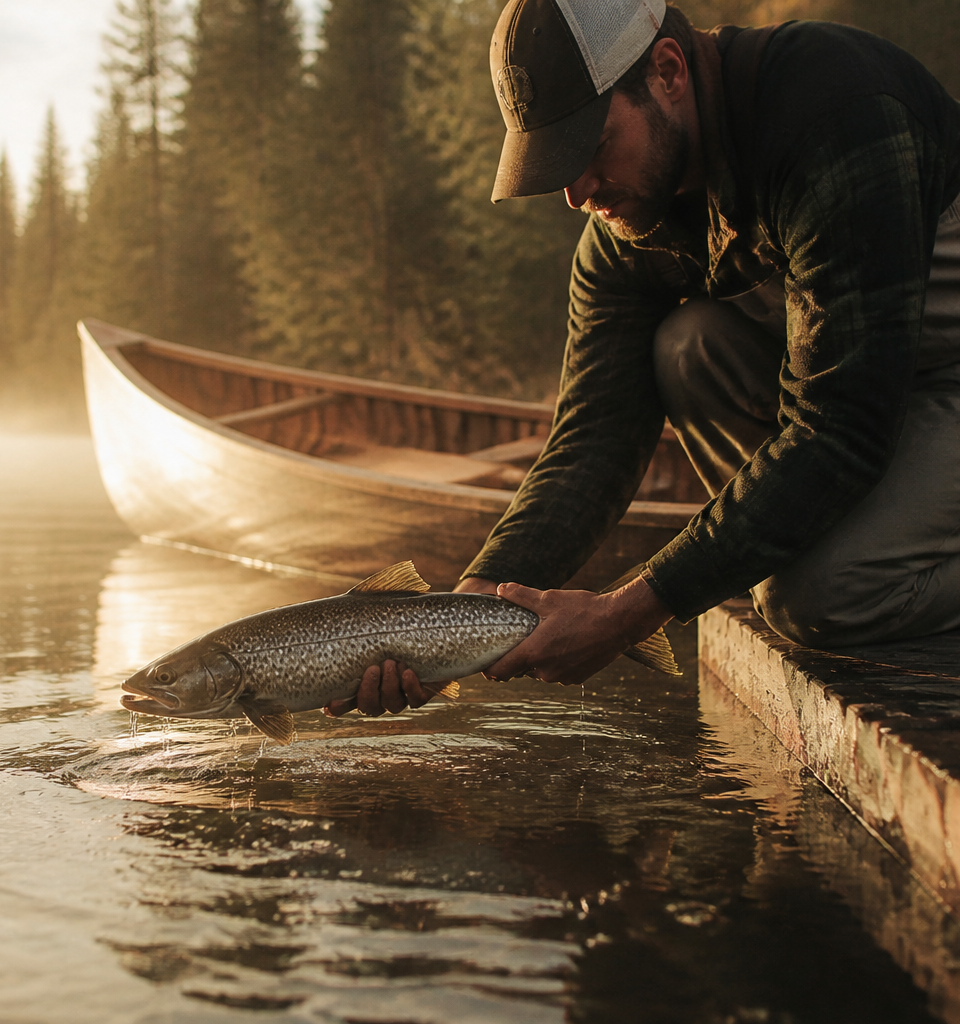
Practicing catch-and-release on trophy-sized fish ensures the longevity of this exceptional resource. Handle catches with wet hands, minimize air exposure to a few seconds for photos, avoid lifting fish vertically by the gills, and support them horizontally in the water until they swim away strong.
Guided Lake trout / charr fishing trips in Saskatchewan
Booking an all-inclusive guided lodge package offers the ultimate way to maximize trophy potential while navigating northern wilderness safely. Veteran guides know every trench, treacherous reef, and seasonal migration route under varying sub-arctic weather conditions.
Fly-in lodge packages transport you by floatplane to remote waters free from heavy fishing pressure, offering fully equipped boats and comfortable accommodations after long days on the water. To discover top northern destinations, explore our Saskatchewan fishing outfitters suited to your adventure style.
Whether aiming for a personal best or planning a wilderness trip with friends, trust experienced outfitters to bring your adventure to life. Plan your next unforgettable outfitter trip on MyOutfitters today and get ready to challenge the giants of the North.
Frequently asked questions
When to fish Lake trout / charr in shallow water in Saskatchewan?
Surface fishing is best from late May to mid-June, right after boreal ice-out. During this short window, lake waters remain cold from top to bottom, encouraging large predators to roam shallow bays and rocky shorelines where they can be caught on light spinning tackle or fly gear.
Where to find the biggest Lake trout / charr in Saskatchewan?
Trophy specimens concentrate in the vast, deep Canadian Shield lakes across the province's north. Lakes like Athabasca, Wollaston, Reindeer, Cree, and Lac La Ronge rank as top destinations for fish over 20 to 30 pounds thanks to deep basins packed with cisco.
What rod size is best for Lake trout / charr?
A medium-heavy to heavy rod measuring 7 to 8 feet with a moderate-fast action is recommended. This length and bend absorb violent headshakes, handle heavy jigs or bottom bouncers, and control powerful runs without risking line breaks.
Are barbless hooks mandatory in Saskatchewan?
Barbless hooks are mandatory on many northern waters and strongly recommended province-wide. Pinched barbs make unhooking in the water much easier, reduce handling stress, and significantly improve post-release survival rates.
How long does a Lake trout / charr live in the North?
A Lake trout / charr in cold northern Saskatchewan waters can easily reach 25 to over 40 years of age. Growth is exceptionally slow in these cold boreal habitats, making large fish true ecological monuments that take decades to develop.
What lures work best for deep-water Lake trout / charr?
Heavy flutter spoons and large soft plastics on 1- to 2-ounce jig heads excel in deep water. Silver, pearl, and blue finishes mimicking cisco and whitefish trigger aggressive strikes when jigged vertically or trolled near bottom structure.
What fishing line should be used for trolling Lake trout / charr?
The ideal setup pairs a 30- to 50-pound braided main line with a 20- to 30-pound fluorocarbon leader. Braided line offers maximum sensitivity with zero stretch for deep hooksets, while fluorocarbon provides abrasion resistance and near invisibility.
How do you release a Lake trout / charr without harming it?
Keep the fish submerged in a knotless rubber net while unhooking and handle it only with wet hands. Never hold fish vertically by the gills, keep out-of-water time under a few seconds for photos, and support the fish horizontally in the water until it swims away under its own power.
Do you need a guide to fish big lakes in Saskatchewan?
Hiring a professional guide is highly recommended on these remote wilderness lakes. Besides ensuring safe navigation around hidden reefs and shifting weather, local guides quickly locate active fish schools based on seasonal patterns, saving valuable time on the water.
How much does a Saskatchewan fishing licence cost for non-residents?
Licence fees vary depending on whether you are a Canadian resident or non-resident alien, as well as the duration chosen (one-day, three-day, or annual). You must purchase your licence online or through an authorized issuer before fishing, and verify the latest annual regulations.