Fishing
Muskie Fishing in Quebec: Tips and Techniques
Discover the secrets of muskie fishing in Quebec: prime habitats, advanced techniques, heavy-duty tackle, and guide tips to land this apex freshwater giant.
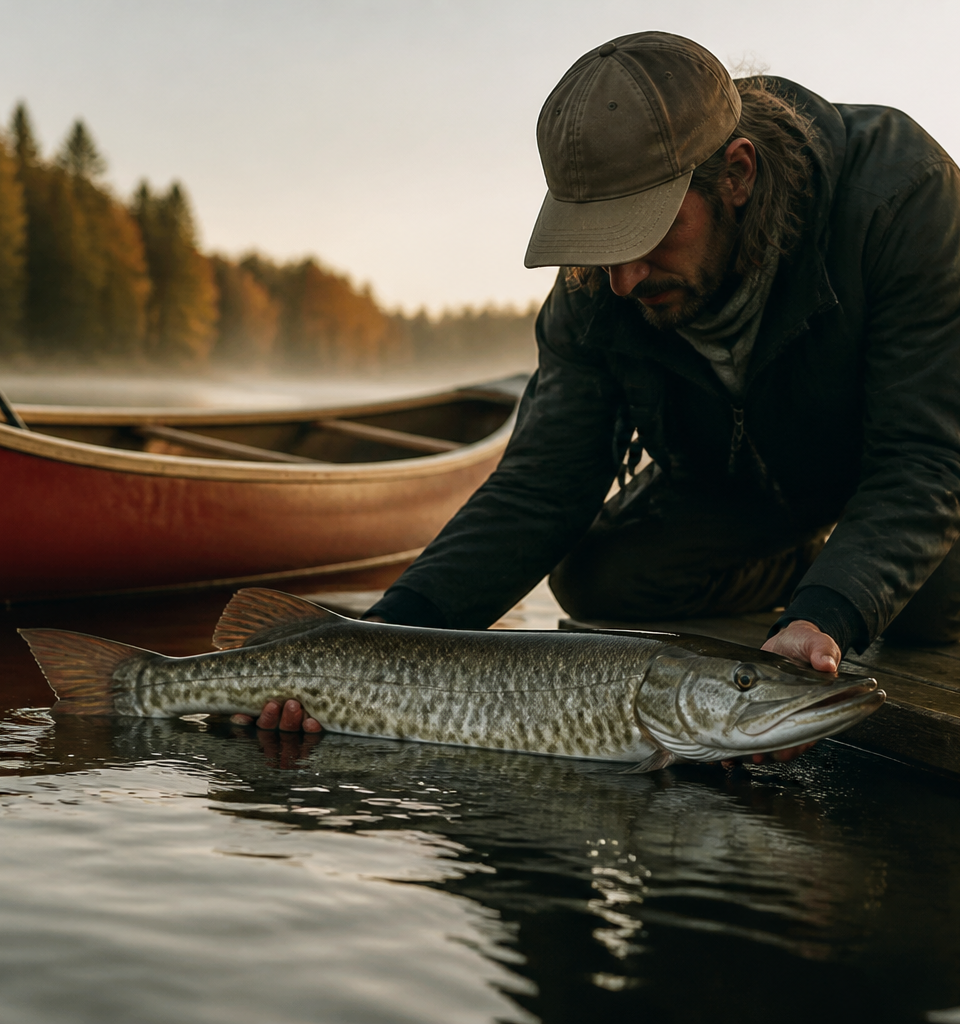
Species overview and identification
The muskellunge (*Esox masquinongy*), or muskie, is the undisputed titan of Quebec's freshwater systems. Respectfully dubbed "the ghost of the water" or "the fish of ten thousand casts," it holds an unmatched mystique for passionate sport anglers. This apex predator belonging to the Esocidae family is recognized by its long, torpedo-shaped, heavily muscled body topped with a flattened duckbill head armed with hundreds of razor-sharp, backward-canted teeth.
Visually, it is often confused with its close relative, the northern pike. However, several reliable markings distinguish the two species without ambiguity. Muskies typically display dark patterns (vertical bars, spots, or mottling) over a lighter background that ranges from olive green to silver-gray or bronze, whereas northern pike feature light spots on a darker background. In addition, a muskie's cheeks and gill covers (opercles) are scaled only on their upper half, leaving the lower half completely smooth.
Another definitive check is examining the underside of the lower jaw: muskies feature 6 to 9 submandibular sensory pores on each side, compared to a maximum of 5 on northern pike. Adult muskies routinely exceed one metre in length, and trophy specimens can achieve incredible girth and weight, turning every hookset into an unforgettable battle.
Habitat and geographic distribution
In Quebec, muskellunge are primarily distributed throughout the southern and southwestern river and lake networks. Healthy, prolific populations thrive throughout the St. Lawrence River and its expansive natural widenings, including Lake Saint-Louis, Lake of Two Mountains, and Lake Saint-Pierre. The Ottawa River, the Richelieu River, and several major tributaries are equally celebrated for holding world-class, trophy-calibre specimens.
As an ambush predator, the muskie relies on complex habitats offering both an abundant forage base and strategic cover. It frequently stakes out positions within or along dense weedbeds of milfoil, pondweed (cabbage), and wild celery. Current-swept rocky points, steep depth breaks, river confluences, and deep bays also serve as high-percentage feeding corridors.
While adaptable across diverse waterways, muskies require clean, well-oxygenated, temperate waters. The combination of prominent subsurface structure and established migration routes for baitfish defines their classic Quebec home range.
Behaviour and seasonal patterns
Muskie behaviour is dictated by water temperature, forage migrations, and spawning cycles. In spring, as ice clears and water temperatures rise between 9 and 15 degrees Celsius, mature adults move into shallow bays and flooded marshes to spawn over dense vegetative substrate. Post-spawn, their metabolism steadily ramps up, prompting active feeding to replenish spent energy stores.
During summer, muskies establish clear seasonal home ranges. They alternate between passive resting periods in deeper water or dense canopy shade and sudden bursts of aggressive feeding triggered by low-light transitions. While territorial, they will readily travel considerable distances to shadow large forage schools, including suckers, walleye, bullheads, and yellow perch.
Fall represents the pinnacle of muskie feeding activity. As winter looms and water temperatures plummet, muskies enter a fall turnover feeding frenzy. Giants abandon dying shallow weedbeds to patrol deep rock structures, saddles, and major drop-offs, gorging on heavy forage to build the fat reserves needed for egg development and over-winter survival.
Best seasons and conditions
While the open season spans from early summer through late autumn, each timeframe offers unique opportunities. June and July deliver visually thrilling fishing around emerging weedlines, where explosive topwater strikes are common, particularly at first light and during dusk.
Autumn, from mid-September until the season closes in November, is unquestionably prime time for targeting Quebec's heaviest trophy muskies. Drastic water cooling drives massive females to feed relentlessly throughout the day. Overcast, raw, and windy days offer classic conditions to trigger strikes from trophy fish.
Weather patterns play an outsized role. Pre-frontal barometer drops, heavy overcast skies paired with a steady surface chop (often called "muskie weather"), and major moon phases (new and full moon windows) are renowned for sparking feeding windows in these notoriously moody predators.
Where and how to find it
Locating muskies across expansive Quebec waters requires disciplined bathymetric map study and careful water reading. The key is pinpointing high-percentage transition zones where structure changes abruptly, creating natural travel lanes for prey and prime ambush points for predators.
- The outside edges of vast weedbeds adjacent to deep water troughs.
- Extended rock or gravel points projecting directly into main-stem river currents.
- Isolated offshore humps and saddles surrounded by deep basins on large lakes.
- Tributary mouths and neck-down narrows between islands where flow accelerates.
A systematic approach with quality sonar helps pinpoint thermoclines and tightly balled baitfish. When approaching structure, position your boat a long cast away to avoid spooking fish in shallow water, and work the water column methodically from top to bottom.
Recommended techniques and strategies
Heavy casting remains one of the most exciting ways to target muskies. This tactic involves casting oversized lures and varying retrieve speeds to provoke aggressive territorial or predatory reactions. Double-bladed bucktails generate massive underwater vibrations detected from afar along the fish's lateral line, while glide baits and jerkbaits deliver erratic, dying-fish action.
At the end of every single cast, executing a deliberate "figure eight" or large oval manoeuvre beside the boat is mandatory. Muskies frequently follow lures right to the boat without committing. By keeping the lure moving fluidly through wide underwater turns and deep figure-eight sweeps right at boat-side, you can convert following fish into visual, heart-stopping strikes.
Structure trolling is an essential strategy across vast open waters and throughout late autumn. It enables anglers to cover expansive territory and keep large crankbaits running precisely along bottom contours and contour breaks. Deploying planer boards spreads lines away from the engine wake, presenting lures silently over shallow reefs and rock piles.
Equipment and gear
Muskie fishing demands heavy-duty gear built to withstand relentless punishment. For casting, choose powerful 8-foot to 9-foot-6-inch rods rated Heavy to Extra-Heavy. This extra length provides the leverage needed to cast lures weighing anywhere from 4 to 16 ounces and facilitates wide, deep figure eights at boat-side.
Pair your rod with a high-capacity, heavy-duty round or low-profile baitcasting reel featuring reinforced brass or steel gearing and a powerful drag system. Spool with 80- to 100-pound test braided line. To withstand the muskie's razor-sharp teeth, a rigid 100- to 150-pound fluorocarbon leader or a solid 100-pound single-strand wire leader is mandatory.
Specialized fish handling tools are equally vital for angler safety and successful fish release:
- An oversized, knotless rubberized landing net (such as a large cradle or deep flat-bottom net).
- Long, heavy-duty needle-nose pliers for safe, deep hook removal.
- High-leverage hook cutters (like Knipex cutters) to quickly snip embedded hooks in critical areas.
- Puncture-resistant fish handling gloves for securely and safely gripping the gill plate.
Regulations, licences and ethical practices
Sport fishing in Quebec is governed by strict regulations designed to sustain wild fish populations. Every angler must hold a valid Quebec sport fishing licence. Muskie opening dates generally occur later in the spring than for other species—often mid-June depending on the fishing zone—to safeguard spawning fish during their reproductive cycle.
Substantial minimum size limits apply across most Quebec waters to ensure fish reach maturity and spawn multiple seasons before harvest eligibility. On several premier fisheries, mandatory catch-and-release rules or highly restrictive possession limits are in place to safeguard unique local trophy genetics.
To review specific zone limits, season dates, and territorial exceptions, visit the Government of Quebec (hunting and fishing). Regulations change annually: always verify the official rules in effect for your specific fishing zone before heading out on the water.
Conservation, population and ecosystem role
Muskies occupy the top tier of the aquatic food web wherever they occur. As apex predators, they play a vital balancing role within freshwater ecosystems, preventing overpopulation of rough fish and naturally culling injured or diseased individuals. However, natural muskie populations naturally occur at very low densities per hectare, making them uniquely susceptible to harvest pressure.
Muskellunge grow relatively slowly; it often takes over a decade for a female to reach the benchmark 50-inch trophy mark. Consequently, Quebec's sport angling community overwhelmingly embraces a strict, 100% catch-and-release ethic for all caught muskies.
Successful catch-and-release hinges on fast, careful handling. Keep the fish in the water inside the landing net while removing hooks. If taking a quick photo, keep it under thirty seconds, always supporting the heavy body horizontally with one hand under the belly and the other at the caudal wrist. During peak summer heat, when surface water temperatures exceed 24 degrees Celsius, anglers should suspend muskie fishing altogether due to high risks of delayed mortality caused by thermal stress.
Planning a guided trip or outfitter stay
Chasing muskies across Quebec's vast waterways is a demanding pursuit with a steep learning curve. Booking a guided trip with an experienced outfitter is the most efficient and educational way to experience this world-class fishery. A seasoned guide understands subtle current seams, tracks seasonal patterns across changing weather conditions, and supplies the specialized heavy tackle necessary for success.
Beyond landing fish, a guided trip teaches best practices for big-water navigation, precise boat positioning, and safe, ethical fish handling. You will learn how to read river currents, position lures with pinpoint accuracy, and maintain composure when a trophy muskie charges your bait right at the boat.
To experience an unforgettable adventure and maximize your chances on the water, plan your next guided muskie excursion through MyOutfitters—your trusted resource for discovering Quebec's premier outdoor destinations and professional outfitters.
Frequently asked questions
How do you tell the difference between a muskellunge and a northern pike?
Muskies feature dark markings (bars, spots, or mottling) on a lighter body, while pike have light spots on a dark background. Muskies also have 6 to 9 sensory pores under each side of their lower jaw (compared to 5 or fewer on pike) and scales only on the upper half of their cheeks.
What is the purpose of the figure eight manoeuvre at boat-side?
The figure eight involves sweeping the rod tip through deep, continuous turns in the water beside the boat at the end of a retrieve. This keeps the lure moving naturally and frequently triggers an aggressive, visual strike from a following muskie before it turns away.
What is the best time of day to catch muskies?
In midsummer, early morning and late evening twilight provide the most productive feeding windows. In autumn, midday hours between 10 a.m. and 3 p.m. often produce the best action as slight water warming activates larger fish.
Why should you avoid muskie fishing during summer heatwaves?
When water temperatures exceed 24°C (75°F), dissolved oxygen drops significantly and intense battles cause severe lactic acid buildup. This creates a high risk of delayed post-release mortality, even if the fish appears to swim away strongly.
What rod rating is recommended for muskie casting?
A heavy-power casting rod rated Heavy to Extra-Heavy, measuring between 8'6" and 9'6", is ideal. This length and power provide the leverage required to throw oversized lures and drive heavy hooks into the muskie's bony jaw.
What are the most effective muskie lures in Quebec?
Double-bladed bucktails, large jointed crankbaits, wooden and hard-plastic jerkbaits or glide baits, oversized soft-plastic tubes, and noisy topwater lures are proven, consistent producers across the season.
How long can a muskie safely be kept out of the water?
Keep out-of-water handling under a strict maximum of 30 seconds, and only lift the fish after all hooks have been safely removed while resting in the submerged net. The less air exposure, the higher the fish's survival rate.
What is the best boat speed for muskie trolling?
During summer, trolling speeds between 5 and 8 km/h (3 to 5 mph) trigger aggressive reaction strikes. In cold late-fall water, slowing down between 3.5 and 5 km/h (2 to 3 mph) is generally more effective for coaxing heavy predators.
Why is a heavy-duty leader essential for muskie fishing?
Muskies have dozens of razor-sharp teeth that easily slice standard braided or monofilament line. A 100- to 150-lb fluorocarbon or 100-lb single-strand wire leader prevents break-offs and avoids leaving lures stuck in the fish.
Why should beginner muskie anglers consider booking a guided outfitter?
An outfitter guide provides intimate knowledge of productive structure, supplies heavy-duty gear, and handles the landing, unhooking, and safe release of large fish, dramatically flattening the steep muskie learning curve.