Fishing
Lake Trout / Charr Fishing in New Brunswick: Expert Guide
Discover the best lakes, trolling techniques, and expert advice to ensure a successful Lake trout / charr fishing season in New Brunswick.
Key takeaways
- The fishing season opens in spring right after ice-out, offering excellent outings right up until the fall closure.
- Deep, cold, well-oxygenated lakes across the northwest and southwest hold the province's best Lake trout / charr populations.
- Deep-water trolling with downriggers or leadcore line remains the top tactic during the summer months.
- Every angler must hold a valid provincial inland fishing licence before casting a line.
- Use a high-performance fish finder to pinpoint the thermocline where baitfish congregate during the summer heat.
Identifying Lake trout / charr in New Brunswick waters
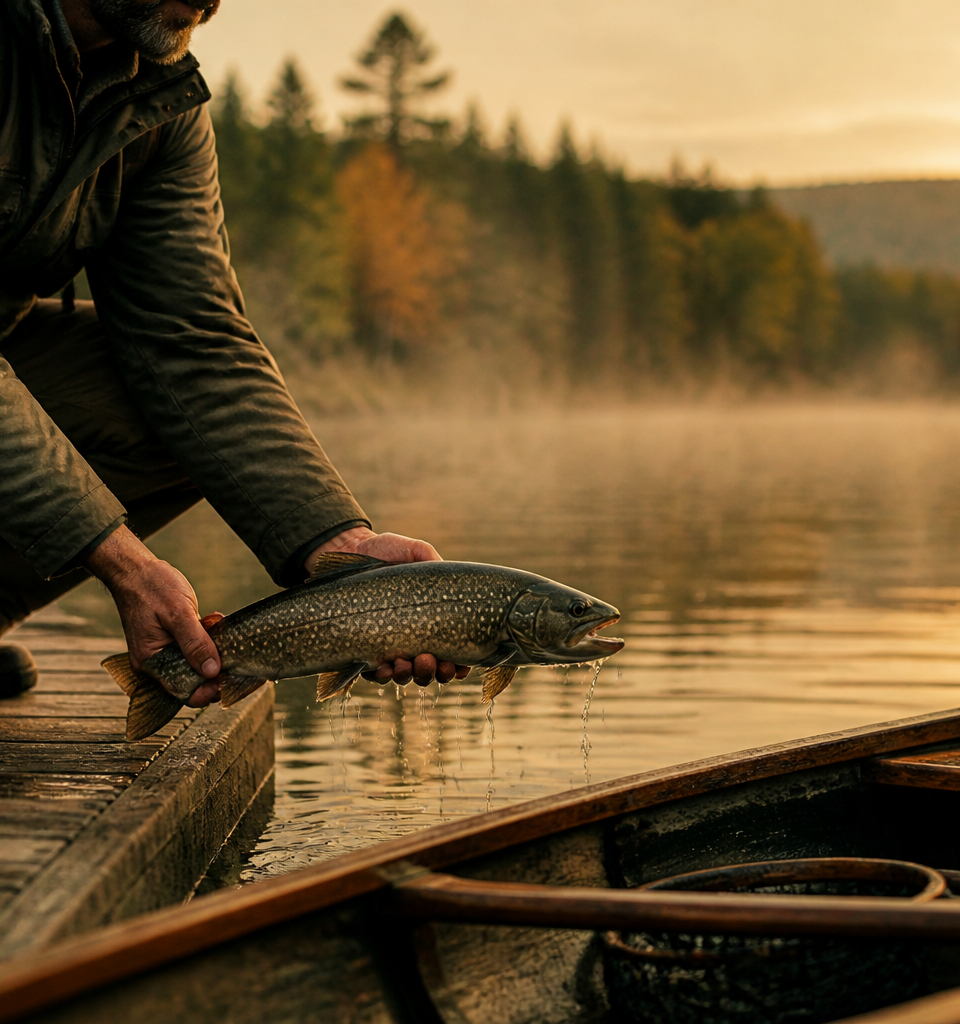
Lake trout / charr, scientifically known as *Salvelinus namaycush* and often called togue or lakers, are easily distinguished from other salmonids by their streamlined, torpedo-shaped body covered in pale spots over a dark background and their deeply forked tail. Unlike brook trout, they never feature blue halos around their spots, displaying coloration that ranges from slate grey to dark olive green.
Their large head features a powerful jaw lined with sharp teeth built to firmly grasp pelagic prey. In the province's major waterbodies, their coloration adapts to water clarity and depth: specimens taken from deep abyssal waters often show bright, silvery flanks, while those from tea-coloured waters keep pronounced bronze tones. If you already practice Brook trout fishing in New Brunswick: Complete guide, you will notice that Lake trout / charr develop a much heavier build, engineered for endurance in vast open waters.
Where to find Lake trout / charr in New Brunswick
Lake trout / charr primarily inhabit large oligotrophic freshwater lakes characterized by significant depths and high concentrations of dissolved oxygen. They are mainly found in two major geographic regions of the province: the northwestern border waters and southwestern watersheds.
Baker Lake and Glazier Lake, located in the Madawaska region, rank among the premier destinations for targeting this apex predator. Further south, lakes within the St. Croix River border system, such as Palfrey Lake and Spednic Lake, feature outstanding deep basins where fish thrive on abundant forage. Grand Lake and certain deep tributaries of the Saint John River basin also hold quality specimens, though fishing pressure and bottom contours differ significantly.
Life cycle and feeding habits of Lake trout / charr
The life cycle of Lake trout / charr revolves around their constant search for cold water between 8 and 12 degrees Celsius. Right after ice-out, when the entire water column maintains a uniform temperature, mature fish and juveniles cruise shallow shorelines and sunlit bays to actively feed on insects, rainbow smelt, and suckers.
As the season progresses and the sun warms surface layers, lakes stratify thermally. Lake trout / charr then dive into the hypolimnion, the stable deep zone where they spend most of the summer suspended below the thermocline. In the fall, cooling water brings spawning fish back toward rocky shoals and wind-swept points, where nocturnal spawning takes place over clean, aerated rubble beds.
When to target Lake trout / charr in New Brunswick
Spring offers the most accessible fishing of the year for Lake trout / charr, as fish hunt near the surface and along rocky shorelines. From May through mid-June, light leadcore lines or flat-line trolling with shallow-running minnow baits produce explosive strikes without heavy specialized gear.
During July and August, the fishery becomes more technical but remains exceptionally productive for anglers who can get down between 15 and 25 metres. Early morning light and calm late afternoons provide prime windows to locate actively feeding fish. The strategy mirrors the techniques detailed in our guide on Lake trout / charr fishing in Quebec: Complete laker guide, where stable barometric pressure strongly influences feeding aggression.
Locating Lake trout / charr in deep structure
To locate summer Lake trout / charr, interpreting underwater topography using bathymetric charts alongside careful sonar analysis is essential. Steep drop-offs plunging into deep basins, submerged points, and underwater humps create textbook ambush areas where predators intercept schools of smelt.
On your sonar screen, look for the thermal boundary layer, often visible as a light band of clutter. The distinctive arches of Lake trout / charr generally appear just beneath this layer or pinned directly against adjacent bottom structure. If fish refuse to bite, adjust your trolling speed before moving spots: a subtle change in pace often triggers a reaction strike from trailing trout.
Best trolling setups for Lake trout / charr
Controlled-depth trolling remains the most reliable method for keeping lures running at the exact depth holding fish. Downriggers allow you to present light flutter spoons without adding sinkers to the main line, preserving the full fight once a fish strikes.
Lightweight flutter spoons with erratic action in silver, pearl blue, or copper are proven producers across New Brunswick waters. Slender minnow plugs imitating rainbow smelt also deliver excellent results when pulled behind bottom bouncers or inline weights. When fish concentrate on tight structural shelves, vertical jigging with heavy tube jigs or metal spoons offers exciting, direct-contact hookups.
Essential tackle and gear for Lake trout / charr
Targeting Lake trout / charr requires a 7 to 8.5-foot medium to medium-heavy trolling rod with a moderate action capable of absorbing powerful headshakes while holding line-release tension. A conventional line-counter reel makes it simple to repeatedly set lures to productive depths with pinpoint accuracy.
Spool your reel with 20 to 30 lb braided line to cut through water resistance cleanly. Always add a 10 to 15 lb fluorocarbon leader of at least three metres to stay invisible to these sharp-eyed predators in clear water. A large, knotless rubber landing net is essential to land fish gently without damaging their protective slime coat.
Regulations for Lake trout / charr fishing in New Brunswick
Sport fishing for Lake trout / charr is governed by designated seasons, daily bag limits, and possession limits that vary by Wildlife Management Zone. Anglers must hold a valid provincial fishing licence and follow gear restrictions, including the use of barbless hooks on designated waters.
Certain border rivers and lakes shared with Maine or neighbouring provinces may be subject to specific joint regulations or slot limits designed to protect mature breeding stock. To review full angling rules and confirm limits for your destination, visit the official Government of New Brunswick website. Regulations change annually; always verify catch limits, open dates, and tackle restrictions with provincial authorities before launching your boat.
Conservation and catch-and-release for wild Lake trout / charr
Due to late sexual maturity and slow growth rates in cold northern waters, Lake trout / charr are particularly vulnerable to overharvest. A large specimen may take well over a decade to reach trophy size, making stock recovery slow if harvest rates run too high.
Practicing careful catch-and-release is vital for sustaining wild populations. When bringing a fish up from deep water, reel at a moderate pace to minimize decompression issues and prevent barotrauma. Keep the fish in the water while removing hooks, avoid prolonged air exposure, and support it gently facing the current until it swims away under its own power.
Booking a guided Lake trout / charr fishing adventure
Planning a trip with a professional guide or staying at an established fishing lodge takes the guesswork out of navigating large, unfamiliar lakes. Local guides possess detailed knowledge of underwater structure, seasonal thermoclines, and daily fish movements based on changing weather.
Through New Brunswick fishing outfitters, you gain access to boats rigged with commercial-grade sonar and quality trolling gear without having to haul heavy tackle yourself. Whether you want to combine your outing with Atlantic salmon fishing in New Brunswick or explore secluded backcountry lakes, fishing with experienced professionals makes for a safe, unforgettable experience.
To find the right destination and book a package tailored to your goals, explore the offerings on MyOutfitters and start planning your next angling trip into the New Brunswick wilderness.
Frequently asked questions
When does the Lake trout / charr fishing season open in New Brunswick?
The season generally opens in early May right after ice-out on large lakes. Spring fishing remains prime through late June, and angling continues through the summer until the official fall closure.
Where are the best lakes for Lake trout / charr in New Brunswick?
Top lakes include Baker Lake and Glazier Lake in the northwest, as well as Spednic Lake and Palfrey Lake along the southwestern St. Croix border system. These deep, cold waterbodies provide ideal habitat.
What is the best lure for Lake trout / charr?
Slender flutter spoons in silver, blue, or copper that imitate rainbow smelt are top choices. Thin minnow stickbaits and heavy tube jigs worked vertically over deep structure are also very productive.
Do you need downriggers to fish for Lake trout / charr?
Downriggers are not mandatory, but they are the most effective tool during summer to target fish sitting 15 to 30 metres down. In spring, flat lines, leadcore, or bottom bouncers easily reach active surface fish.
How many Lake trout / charr can you keep per day in New Brunswick?
Daily limits depend on the specific Wildlife Management Zone and waterbody. Bag limits are strictly managed to protect stocks and typically allow one or two fish per day where harvest is permitted.
What depth should you target for Lake trout / charr in mid-summer?
During the heat of July and August, focus beneath the thermocline, typically between 15 and 28 metres deep, where cold, well-oxygenated water holds active fish and bait.
How do you prevent barotrauma when releasing Lake trout / charr?
Retrieve deep-water fish slowly and steadily to let them equalize pressure. Unhook the fish quickly in the water without lifting it into the boat, and revive it facing into the current before release.
What is the minimum legal size for keeping Lake trout / charr?
Size restrictions vary across individual lakes and provincial zones, often incorporating slot limits to protect spawning fish. Always check the current provincial angling guide for your lake's exact limits.
Can you catch Lake trout / charr on a fly in New Brunswick?
Fly fishing is productive and exciting in early spring when water temperatures remain cold near the surface. Sinking lines paired with large smelt-pattern streamers worked over rocky shoals yield great results.
Do you need a guide to fish large New Brunswick lakes?
A guide is not legally required, but hiring one is highly recommended to quickly locate deep holding areas, navigate large waters safely, and access specialized downrigging gear and sonar electronics.