Fishing
Atlantic Salmon Fishing in Quebec: The Complete Angler's Guide
Discover the art of Atlantic salmon fishing in Quebec: legendary rivers, fly-fishing techniques, reading salmon pools, and expert advice for a successful trip.
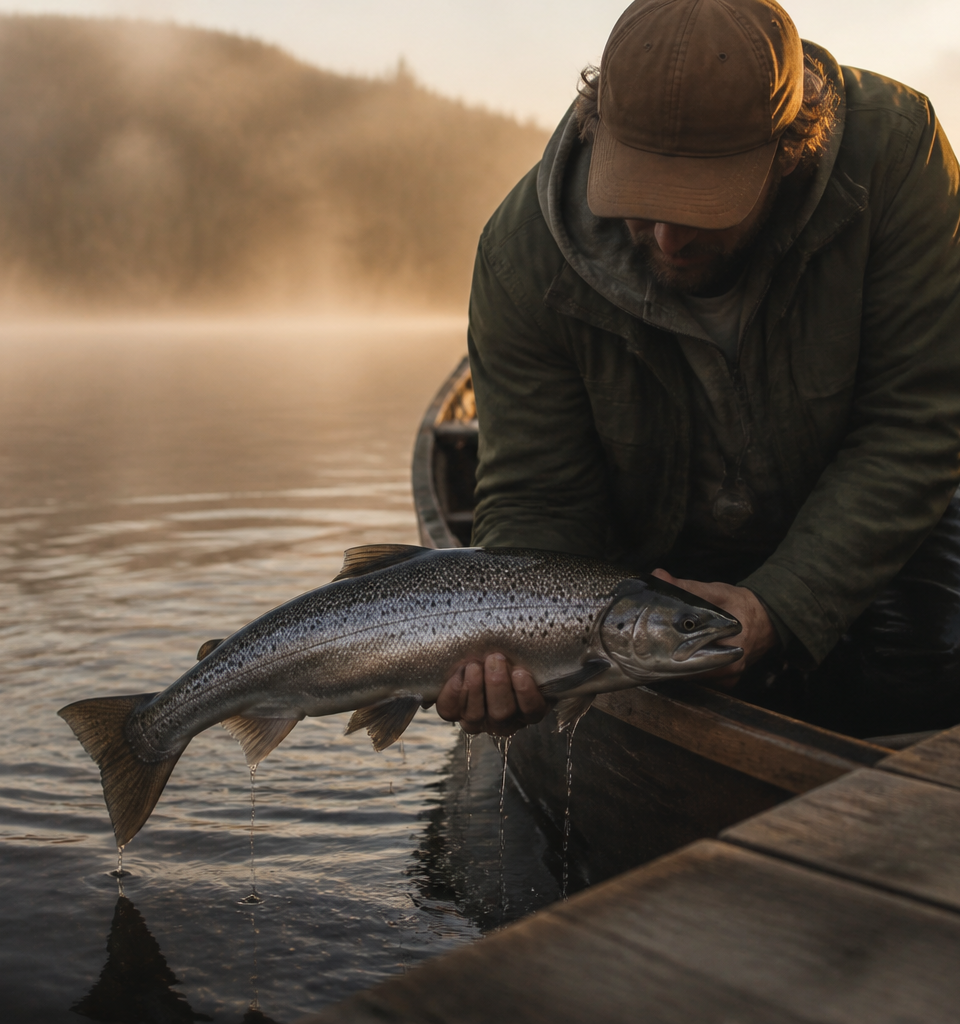
Species overview and identification
The Atlantic salmon (*Salmo salar*), reverently hailed as the king of game fish, remains the undisputed monarch of Quebec's rushing waters. This remarkable anadromous migrant features a sleek, muscular, torpedo-shaped body engineered to cut through heavy currents and conquer imposing waterfalls. While at sea and upon first entering freshwater, it displays an unmatched silver sheen, with bright flanks and a back transitioning from steel blue to olive green, dotted with distinct cross-shaped black spots.
As it stays longer in freshwater, its coloration undergoes a dramatic metamorphosis. Its flanks gradually turn bronze, copper, and dark brown, particularly in males, which develop an impressive hooked lower jaw known as a kype. Anglers primarily encounter two types of runs: grilse, which return to spawn after a single winter at sea and typically weigh between one and three kilograms, and multi-sea-winter (MSW) large salmon, which spend two or more winters in the ocean and can exceed ten to fifteen kilograms.
It is essential not to confuse anadromous Atlantic salmon with the landlocked salmon (ouananiche), a freshwater-only form residing in large interior lakes, or with sea-run brook trout (salters), whose distinct worm-like vermiculations and square tail set them apart from the salmon's noticeably forked caudal fin.
Habitat and geographic distribution
Quebec boasts one of the most pristine and prolific Atlantic salmon river networks on the planet, with over one hundred catalogued salmon rivers. These waterways are defined by cool, highly oxygenated, crystal-clear water flowing through the boreal forest and rugged coastal valleys. An ideal salmon river features a riverbed of cobble, clean gravel bars, and large boulders that create vital hydraulic resting lies.
The species' geographic distribution spans several iconic regions. The Gaspé Peninsula is home to legendary emerald-tinted rivers such as the Matapédia, Bonaventure, Grand Cascapédia, and Sainte-Anne. The Côte-Nord (North Shore) offers a wilder, untamed wilderness with powerful, majestic rivers like the Moisie, Trinity, Godbout, and the Sainte-Marguerite in the Saguenay Fjord.
Further east, Anticosti Island delivers a distinct island experience with rivers carving through narrow limestone canyons. Finally, the Lower Saint Lawrence, Charlevoix, and the far northern reaches of James Bay and Nunavik also feature wild rivers where anadromous salmon complete their ancestral journey far from human disturbance.
Behaviour and seasonal patterns
The life cycle of the Atlantic salmon is an endurance epic. Born in the gravel redds of their natal rivers, alevins grow into parr and eventually into smolts. Around two to four years of age, they undergo a physiological transformation that prepares them for saltwater before migrating thousands of kilometres to North Atlantic feeding grounds near Greenland and the Labrador Sea.
Following rapid marine growth, spawning instinct guides mature adults back to their river of birth with pinpoint accuracy. This river run kicks off in early summer. The moment salmon enter freshwater pools from the estuary, they cease feeding entirely. Their digestive tract atrophies, and they survive exclusively on fat reserves built up in the open ocean.
This physiological quirk creates the ultimate fly-fishing mystery: why does a fish that no longer eats strike an artificial fly? Biologists and seasoned anglers believe it is a combination of territorial instinct, residual aggression, predatory reflexes retained from the juvenile stage, and sheer curiosity toward an intriguing swing or drift.
Best seasons and conditions
The Quebec salmon season generally runs from early June through late September or mid-October, depending on the fishing zone. Early season (June to early July) corresponds with the arrival of fresh, sea-bright chrome fish fresh off the tide, renowned for their explosive fighting power. Water levels are typically high and water temperatures cool, making salmon receptive to larger offerings swung through the current.
Midsummer (July and August) brings lower water levels and gin-clear conditions, demanding a much more delicate approach. This is the prime window for surface dry-fly fishing, especially in the cool early mornings or late evenings as the sun dips and water temperatures moderate.
Autumn (September to early October) brings another surge in activity. Salmon take on their dark spawning dress, growing territorial and aggressive ahead of spawning. Ideal conditions include overcast skies, a light mist, and steady water temperatures between 10 and 16 degrees Celsius. If water temperatures spike past 20 degrees Celsius, salmon become lethargic, requiring ethical anglers to voluntarily suspend fishing to protect the fish from heat stress.
Where and how to find it
Locating Atlantic salmon requires carefully reading river structure. Unlike stationary warmwater predators, salmon seek resting lies where energy expenditure against the current is minimized while oxygen levels and safety from predators remain optimal. These holding spots are known as pools.
Within any given pool, holding lies shift depending on river flow and temperature:
- Pool head: Where fast, broken water enters and oxygenates the pool over submerged rocks—especially productive early in the season or during warm weather.
- Mid-pool belly and mirror: A transition zone where the current slows, providing deep, secure holding water for pods of resting salmon.
- Pool tail-out: The shallower flat section just above a downstream drop-off or rapid, highly productive at dawn and dusk when salmon slide back to rest in the surface flow.
In the crystal-clear waters of the Gaspé or the North Shore, spotting salmon is often visual. Polarized sunglasses with amber or copper lenses are essential to cut through surface glare and spot the long, dark silhouette of a salmon tucked behind a boulder.
Recommended techniques and strategies
Under Quebec regulations, fly fishing is almost universally the only legal method for Atlantic salmon. Two primary strategies dominate the sport: wet-fly swinging and dry-fly presentation.
Wet-fly fishing is traditionally performed by wading downstream step by step. The angler casts across and downstream at roughly a 45-degree angle toward the far bank, mends the line upstream to control speed, and lets the fly swing through the pool on a steady arc. Takes often occur at the apex of the swing or just as the fly hangs down directly below the angler.
Dry-fly fishing is widely regarded as the most thrilling aspect of the sport. Whether drifted dead-drift over a salmon's lie or skated across the surface with subtle twitches (including the classic riffle hitch technique), a waking dry fly coaxes salmon up through the water column for an explosive surface take. Patience is crucial: never set the hook on the initial rise; wait a split second until the fish turns downward to securely set the hook in the corner of the jaw.
Equipment and gear
Tackling a wild Atlantic salmon demands dependable, high-performance gear. A 9-foot, 7-to-9-weight single-handed fly rod is the classic, versatile workhorse across most Quebec rivers. On wide, powerful rivers across the North Shore and the Gaspé, a two-handed Spey or Switch rod (11 to 13 feet, 7 or 8 weight) allows for effortless long-range casts and exceptional line control over complex currents.
The fly reel must feature a smooth, sealed, reliable drag system built to handle blistering runs through heavy rapids. It should accommodate at least 150 to 200 metres of 20- to 30-pound backing beneath a weight-forward floating line.
For leaders, use tapered monofilament or fluorocarbon setups between 9 and 14 feet, with tippet strengths ranging from 8 to 15 pounds depending on water clarity. When stocking your fly box, carry proven Quebec classics:
- Wet flies: Rusty Rat, Green Highlander, Blue Charm, Cosseboom, Black Bear Green Butt, and Undertaker.
- Dry flies: Bombers (olive, brown, orange, or natural bodies with white or grizzly hackle), Carter's Bug, and the Wulff series.
Regulations, licences and ethical practices
Atlantic salmon fishing in Quebec is strictly regulated to ensure resource sustainability. Every angler must carry a specific provincial Atlantic salmon fishing licence (with or without mandatory catch-and-release provisions) and pay daily access fees to the river's managing body (Salmon ZEC, outfitter, or wildlife reserve).
Rules regarding retention quotas, size limits, mandatory release of large salmon, and the mandatory use of single barbless hooks vary across fishing zones, individual rivers, and controlled-access beats. Registering all catches at local check stations is a mandatory legal requirement.
For detailed legal frameworks by zone, visit the official Government of Quebec (hunting and fishing) website. Regulations change annually: always verify current local rules before stepping onto the river.
Conservation, population and ecosystem role
Atlantic salmon play an essential ecological role as an umbrella species and bio-indicator of watershed health. By carrying massive quantities of ocean-derived marine nutrients upstream into boreal river valleys during their spawning runs and natural lifecycle, salmon enrich riparian food webs and sustain terrestrial wildlife.
Despite their resilience, Atlantic salmon face global challenges: warming oceans shifting marine migration routes, increased predation, invasive competitors, and summer heatwaves driving thermal stress in river systems. In Quebec, conservation management based on spawning escapement targets (the minimum number of breeding adults needed to sustain a river's population) has preserved robust runs compared to many regions worldwide.
Responsible catch-and-release practices by the angling community remain a cornerstone of this conservation success. By keeping fight times short, keeping fish fully submerged in the water during hook removal, and handling them only with wet hands, anglers actively safeguard this living heritage for future generations.
Planning a guided trip or outfitter stay
Booking an Atlantic salmon trip with a Quebec outfitter is the most rewarding, hassle-free way to experience this world-class fishery. Specialized outfitters provide exclusive or private access to renowned river beats, bypassing public river draws and guaranteeing uncrowded, pristine water.
Fishing alongside a professional local guide transforms the entire experience. A skilled guide knows every hidden rock, current seam, and salmon lie across varying water levels. They will recommend the right fly pattern, refine your casting technique, and safely net and handle your fish. Furthermore, premier lodges offer warm, rustic hospitality, regional Quebec cuisine, and comprehensive trip logistics.
To find the destination that best suits your goals and live an unforgettable adventure on Quebec's legendary salmon rivers, plan your next guided outfitter trip through MyOutfitters.
Frequently asked questions
Is fly fishing mandatory for Atlantic salmon in Quebec?
Yes. On virtually all designated salmon rivers in Quebec, fly fishing with artificial flies is the only legal method. Spinners, spoons, natural bait, and treble hooks are strictly prohibited to protect spawning fish and minimize handling injury.
What is the difference between a grilse and a large salmon?
A grilse is an Atlantic salmon that returns to spawn after spending just one winter at sea; it typically weighs under 3 kilograms (roughly 6 pounds). A large salmon spends two or more winters in the ocean, frequently reaching 5 to 10 kilograms (11 to 22+ pounds) or more.
What type of fly line is best for beginner salmon anglers?
A standard weight-forward floating line (WF8F) paired with an 8-weight rod is the recommended all-around choice. It allows you to cast both traditional wet flies and bulky surface Bombers comfortably while simplifying line mending across varied currents.
Why does Atlantic salmon strike a fly if it does not eat in freshwater?
Once in freshwater, salmon stop feeding and live off stored marine energy reserves. Strikes on artificial flies are triggered by territorial aggression, predatory reflexes held over from their juvenile stage, or instinctual curiosity stimulated by the fly's movement.
How do you safely practice catch-and-release on Atlantic salmon?
Keep the salmon fully submerged in water, use a knotless rubber landing net, unhook the fly using forceps or pliers, and avoid removing the fish from the water for photos. Support the fish upright facing a gentle current until it kicks away strongly under its own power.
What should anglers do when river water gets too warm in summer?
When water temperatures reach or exceed 20 degrees Celsius, salmon experience severe thermal stress, and post-release mortality increases dramatically. Ethical anglers stop fishing or restrict their outings strictly to the coolest hours around sunrise.
What are the most versatile wet-fly colours for salmon?
Patterns incorporating black, green, brown, blue, and copper are dependable staples. Classic patterns like the Green Highlander for bright clear water, the Rusty Rat for tea-stained flows, and the Black Bear Green Butt for overcast days cover the vast majority of river conditions.
Are barbless hooks mandatory on Quebec salmon rivers?
Yes, Quebec regulations require single barbless hooks (or hooks with the barbs completely pinched down) on salmon waters. This rule speeds up unhooking, minimizes tissue damage, and significantly improves survival rates for released fish.
What is the advantage of using a Spey rod over a single-handed rod?
A two-handed Spey rod allows anglers to launch long casts using water-loaded anchor casts without needing backcast clearance. It is ideal for broad, powerful rivers and heavily forested banks where traditional overhead casting is obstructed.
Why should I book a trip with an outfitter and guide?
A professional guide knows river depths, current dynamics, and prime holding lies at every water stage. Guided outfitter packages maximize hookup rates, accelerate your casting skills, and secure seamless access to premier salmon beats.