Fishing
Atlantic Salmon Fishing in Nova Scotia: Angler's Guide
Discover the secrets of Atlantic salmon fishing in Nova Scotia: legendary rivers, run timings, proven fly patterns, and expert techniques.
Key takeaways
- Sport fishing for Atlantic salmon takes place primarily from June through late October, depending on open river systems.
- Rivers across Cape Breton and the Northumberland Shore feature cold-water pools renowned for productive late-season runs.
- Fly fishing with a single barbless hook is the exclusive legal angling method on all designated salmon waters.
- A specific provincial salmon licence is mandatory, and catch-and-release is strictly required for all hooked salmon.
- Anglers must monitor summer river temperatures, as warm-water protocols automatically close rivers during critical heat periods.
How to identify running Atlantic salmon?
Atlantic salmon (*Salmo salar*) are recognized by their streamlined, silver bodies dotted with distinct cross-shaped or crescent black spots. Fresh from the ocean, they exhibit bright chrome flanks and a snow-white belly—hallmarks of vigorous, fresh-run fish. The caudal fin is slightly forked or square, and the slender wrist (caudal peduncle) allows for a secure grip during in-water handling.
As their stay in fresh water extends toward the fall, Atlantic salmon undergo a dramatic physical transformation. Males develop rich copper-bronze tones, reddish hues, and a hooked lower jaw known as a kype. Females transition to darker, olive-tinged flanks. Unlike Pacific salmon species, Atlantic salmon do not automatically die after spawning, retaining the strength and condition to return to the sea.
Atlantic salmon rivers and habitats in Nova Scotia
Atlantic salmon thrive in Nova Scotia's well-oxygenated river systems, characterized by clean gravel beds and steady, moderate currents. The waterways of Cape Breton Island—most notably the world-renowned Margaree River—form the heart of the province's salmon angling heritage. Nova Scotia's river valleys create an ideal progression of gravel riffles, rolling rapids, and deep, sheltered holding pools.
Beyond Cape Breton, select coastal streams emptying into the Northumberland Strait and along the Guysborough coast also support notable runs. Salmon frequently seek out confluence zones where cold tributary brooks temper the main river's heat during midsummer. Anglers looking to explore diverse cold-water fisheries often pair their trips with Brook trout fishing in Nova Scotia: Complete guide across these same forested watersheds.
Atlantic salmon run cycles in rivers
The annual river cycle of Atlantic salmon features two distinct runs depending on the watershed. The early run, composed of active grilse and multi-sea-winter fish, typically arrives in late spring as early summer flows remain strong. These summer fish push quickly into upper reaches, using high water to clear rocky ledges and settle into upstream holding pools.
The second run, a hallmark of Nova Scotia's maritime fisheries, peaks in the autumn between September and October. This late run brings the largest specimens of the year, stirred into activity by cool autumn rains. After overwintering or spawning on gravel redds in November, surviving salmon become spring "kelts" (or black salmon), dropping back down to the Atlantic upon ice-out to feed at sea once again.
When to fish for Atlantic salmon in Nova Scotia?
The autumn window from mid-September through late October generally offers the highest probability of success in Nova Scotia. Crisp fall nights cool river temperatures significantly, reigniting aggressive takes from resident pool-holding fish. The stunning autumn foliage along the Margaree Valley coincides with prime water levels for swinging wet flies.
Early-season angling in June and July also provides great action as fresh fish enter on early spates. Mid-August, however, demands extra caution due to low water levels and elevated temperatures that drive fish into thermal refuge pockets. Anglers comparing regional fisheries can explore Atlantic salmon fishing in New Brunswick: Expert guide to dial in their timing across Eastern Canada.
Locating Atlantic salmon pools in Nova Scotia
Locating Atlantic salmon requires reading current seams and structural breaks at the heads and tails of pools. Fish rarely hold in the deepest, dead-water sections; instead, they position themselves on the pool tail-out or along gravel troughs where accelerating water provides steady oxygen. Submerged boulders and ledge pockets create current breaks where running fish stop to rest.
Careful surface observation is essential before stepping into the water to cast. A fish quietly porpoising signals its presence, while a salmon jumping erratically is often repositioning or unsettled. Polarized sunglasses on bright days allow anglers to scan gravel runs and pick out the dark, stationary silhouettes of resting salmon.
Fly fishing techniques for Atlantic salmon
The traditional wet-fly swing at a 45-degree angle remains the quintessential method for targeting Atlantic salmon. Anglers cast across and slightly downstream toward the far bank, allowing the fly to swing through the holding seam in a controlled arc while managing line speed with upstream or downstream mends. Strikes frequently occur on the dangle, just as the fly straightens directly below the rod.
Dry-fly fishing on the surface, particularly with spun-deer-hair Bombers, delivers thrilling takes. Skated or dead-drifted over a sighted lie, a buoyant Bomber in natural brown, green, or white triggers explosive surface rises from otherwise dormant fish.
Choosing gear for Atlantic salmon
A 9-foot, 8-weight single-handed fly rod serves as the all-around standard for Nova Scotia rivers. This setup provides ample backbone to turn over bulky flies in stiff coastal winds while maintaining the delicacy required for low-water presentations. Two-handed Spey and switch rods in the 11- to 13-foot range are increasingly popular for effortlessly covering wide pools with limited backcasting room.
A reliable fly reel with a smooth, sealed drag system and at least 150 metres of 30-pound backing is vital. A weight-forward floating line forms the baseline, paired with a tapered monofilament leader ending in an 8- to 12-pound tippet. Anglers familiar with Atlantic salmon fishing in Quebec: Complete angler's guide will recognize staple fly patterns such as the Rusty Rat, Cosseboom, and Undertaker.
Atlantic salmon fishing regulations in Nova Scotia
Provincial and federal regulations mandate strict catch-and-release for all wild Atlantic salmon, from grilse to multi-sea-winter spawners. Angling is restricted exclusively to artificial flies on single barbless hooks (or hooks with pinched barbs) across designated salmon waters. Every angler must carry a valid resident or non-resident salmon fishing licence.
Water temperature monitoring protocols are strictly enforced: when river temperatures exceed safe thresholds during midsummer heat waves, fisheries managers enact temporary pool or river closures to prevent stress-induced fish mortality. Review up-to-date river classifications, boundary markers, and seasonal dates via the official Government of Nova Scotia portal. Regulations change annually: always verify current rules and local orders with provincial authorities before heading out on the water.
Conservation and future of Atlantic salmon populations
Conserving Atlantic salmon populations depends on proactive habitat stewardship and watershed management. River associations, community groups, and fisheries biologists work together to remediate silted spawning beds, stabilize eroding banks, and remove fish passage barriers to ensure unhindered migration.
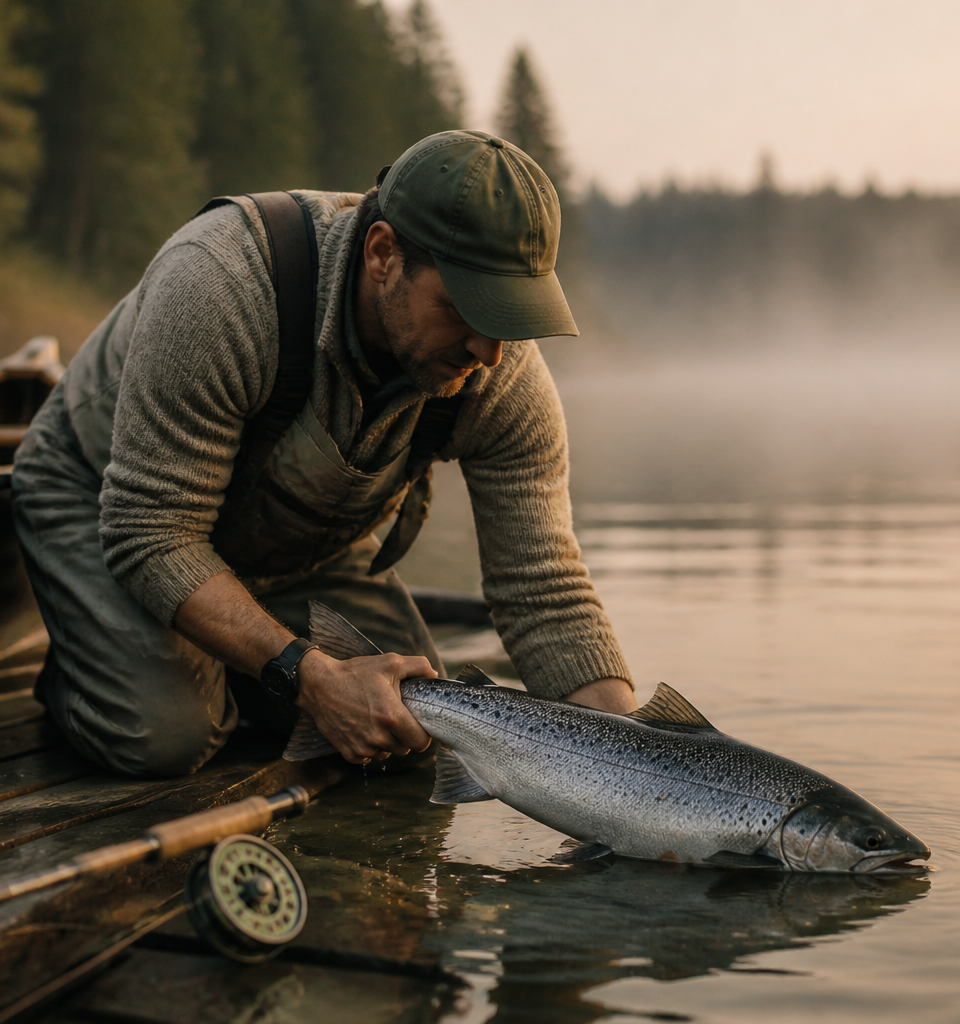
Angler ethics directly support these conservation goals. Minimizing fight times with properly matched tackle, keeping fish submerged in the water at all times, and using knotless rubber landing nets significantly increase post-release survival rates. These practices safeguard a storied wild fishery for generations to come.
Booking a guided Atlantic salmon fishing trip
Hiring an experienced local guide elevates a salmon fishing trip on Nova Scotia rivers. A professional guide brings intimate knowledge of pool dynamics, water-level shifts, and hourly fish movements between holding lies, while ensuring fish handling adheres to best conservation practices.
Waterfront lodge accommodations and outfitter packages streamline the logistics of an extended stay. To arrange your trip and secure professional guiding, explore the options available through Nova Scotia fishing outfitters.
Start planning your next fly-fishing adventure on MyOutfitters to experience world-class salmon waters across Eastern Canada.
Frequently asked questions
When does Atlantic salmon season open in Nova Scotia?
The open season generally begins on June 1 across most designated rivers in Nova Scotia, though specific opening dates vary by watershed. Angling extends through late October, when prime autumn runs enter Cape Breton river systems.
Can you keep an Atlantic salmon caught in Nova Scotia?
No, all Atlantic salmon caught in Nova Scotia must be released alive immediately. Mandatory catch-and-release applies to all fish, including grilse and large multi-sea-winter salmon, to protect wild breeding stocks.
What fly gear do you need for Atlantic salmon in Nova Scotia?
A 9-foot, 8-weight single-handed fly rod with a floating line is the standard setup. Spey rods between 12 and 13 feet are widely used on larger rivers. Pair your rod with a durable reel holding at least 150 metres of backing and quality tapered leaders.
What are the best Atlantic salmon rivers in Nova Scotia?
The Margaree River on Cape Breton Island is the province's premier destination, globally known for its public pools and autumn runs. The North River, Baddeck River, and select Northumberland Strait rivers also offer productive sport fishing.
Is a guide required for non-resident salmon anglers in Nova Scotia?
No, non-resident anglers are not legally required to hire a licensed guide on most Nova Scotia salmon waters. However, hiring an experienced local guide is strongly recommended to learn pool access, local etiquette, and productive fly water.
What are the top fly patterns for Atlantic salmon in Nova Scotia?
Standard wet flies such as the Rusty Rat, Green Highlander, Undertaker, and Blue Charm are highly effective. For surface fishing, spun-deer-hair Bombers in natural, brown, and green patterns produce exciting topwater takes.
What licence is required to fish for Atlantic salmon in Nova Scotia?
Anglers require a dedicated provincial Atlantic salmon fishing licence, separate from the general freshwater sportfishing licence. Licences are available to residents and non-residents through authorized vendors and government offices.
How many flies can you use at one time in Nova Scotia?
Anglers may fish only one single artificial fly at a time on designated salmon waters. The fly must be tied on a single barbless hook (or have its barb pinched flat) to minimize injury and facilitate rapid release.
Why do some salmon pools close during midsummer in Nova Scotia?
Pools and river sections close when water temperatures reach critical thresholds that cause dangerous thermal stress in salmon. As dissolved oxygen drops, fish gather in cold-water holding pockets where fishing is temporarily suspended by regulation to prevent mortality.
What is the proper way to release an Atlantic salmon?
Keep the fish submerged in the water at all times, avoiding lifting it into the air for photographs. Use a knotless rubber net, remove the hook gently with forceps, and support the fish facing into the current until it swims away under its own power.